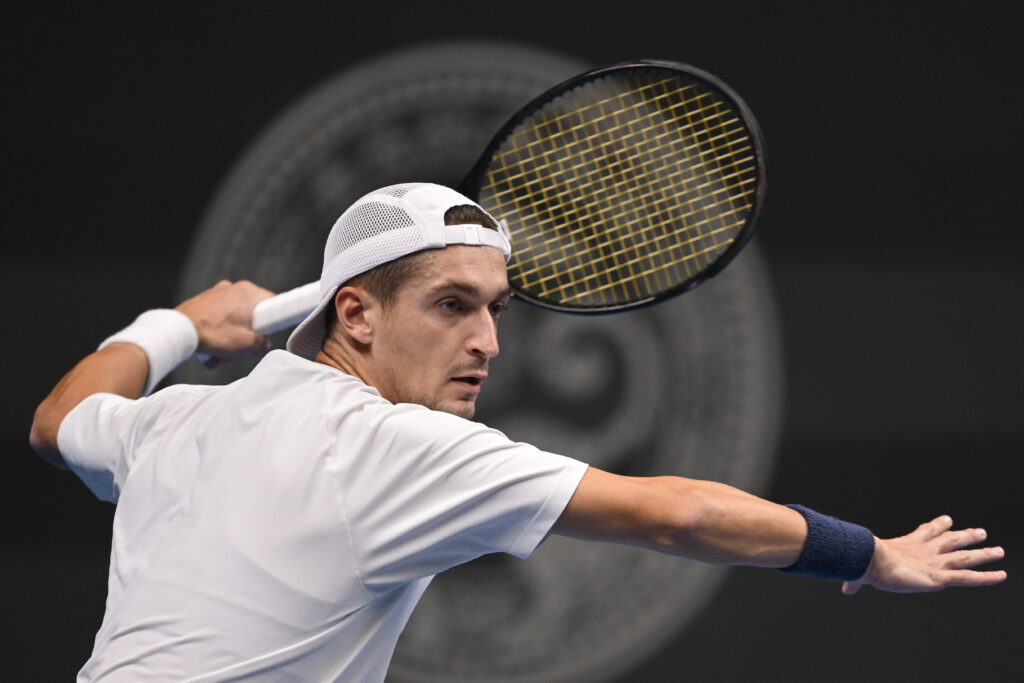



PARIS – Come Monday, he will be the world’s tenth-ranked tennis player, but the greatest contribution Flavio Cobolli is making to his sport has nothing to do with rankings or results, but rather with his joy and charisma.
In a sport like tennis, where all too often we hear talk of ‘sacrifices’ and dissatisfaction from young players who are successful and millionaires, Cobolli represents a return to common sense, a normality that is all too often missing.
You only have to listen to him to understand why. After losing the final at Roland Garros, the Italian gave a true lesson in good taste and human decency.
“I want to congratulate Sascha on this title. I think he deserves it. I also think that today he deserved it more than I did at the end of the match. But I also want to thank myself for what I’ve done over the last two weeks. I would never have imagined such a result in my life, and I’m very proud of myself. So now I just want to smile from ear to ear and enjoy the evening with friends, with the people I love.‘
A ’smile from ear to ear” after losing a final. You don’t often hear that in tennis, where a sense of reality is often lost. Cobolli is exactly the kind of star men’s tennis needed.
‘It’s a Grand Slam final; I don’t think anyone in this room expected much from me,’ he told reporters. ‘So I have to be proud of myself and keep trying again and again.’
Cobolli, aged 24, masterfully crafts a narrative that blends simplicity with touches of humour, as well as a subtle, self-deprecating irony. The result is that in record time he has become one of the circuit’s favourite players: anyone would want a son, a brother, a friend or a boyfriend like him.
It is the triumph of simplicity. Men’s tennis, which has been under considerable strain of late, is dominated by the Italian Jannik Sinner, a very low-key figure who has already admitted he isn’t keen on speaking to the media after every match, and the Spaniard Carlos Alcaraz, a whirlwind who for some time now seems to have been tamed so that his statements are as smooth as possible. Speaking from a clear script to avoid trouble.
Cobolli is different; he speaks off the cuff, and what he says sounds genuine. The 24-year-old Italian has been coached since the age of 17 by his father, Stefano, who reached number 236 in the rankings in 2003. During his childhood and adolescence, father and son agreed they would not talk about tennis, but they would talk about football, the other great passion of the Roland Garros finalist. Until Stefano, now 49, felt that Flavio was ready and took charge of his transition to the professional ranks.
Francesca is Cobolli’s mother, and the player dedicated some deeply emotional reflections to her this Sunday.
‘I practically only saw my father at dinner time, so I spent the whole day with my mother; she used to tell me off for everything, she was there at every training session, so I didn’t have a car until I was 16 or 17; besides, in Rome, you can imagine how dangerous cars and motorbikes are, so my parents never trusted me and always preferred to accompany me.’
What her son does in tennis is a matter of absolute priority for Francesca, Flavio explained some time ago.
‘She doesn’t take the matches very well, and she’s also very superstitious. She puts on a brave face; she’s even gone so far as to lock herself in the bathroom for five hours because she’d won a match. She’s very superstitious and you mustn’t interfere with her rituals.’
Francesca was in Paris today, at the Philippe Chatrier stadium.
‘We have to thank her; I think she deserves to have been here today; she never comes, almost never, precisely because that’s how we are in the family. My mother plays an important role in my life, but I think she’s now found her balance by staying at home, being with my brother, working. So she only comes when she feels the need to be there, to bring me some positive energy.’
There is no arrogance or vanity in Cobolli, but rather genuine amazement at what he has achieved over these two weeks.
In the final he lost this Sunday in five sets to Germany’s Alexander Zverev, Cobolli produced sublime points and glaring errors. Nothing sums this up better than the last two points of the fourth-set tie-break, which the Italian won 7-5.
On the first point, with Zverev beaten and pinned at the back, Cobolli had a very straightforward volley to play, yet the shot sailed several metres wide. But on the next point he redeemed himself with a parallel forehand brimming with power and precision. The sublime and the dreadful. Flavio Cobolli, take it or leave it.
What happened on those two points? The question could be extended to the whole match.
“I closed my eyes,” replied the Italian.
“On both points or just the first one?” the journalist wanted to know.
“Perhaps on both,” said Cobolli with a smile. “To be honest, I was feeling tired in the tie-break, but I also told myself to go out and go for the points, that perhaps I’d win the set and then I could see what happened in the fifth. But yes, I think I closed my eyes. That helps sometimes.”