

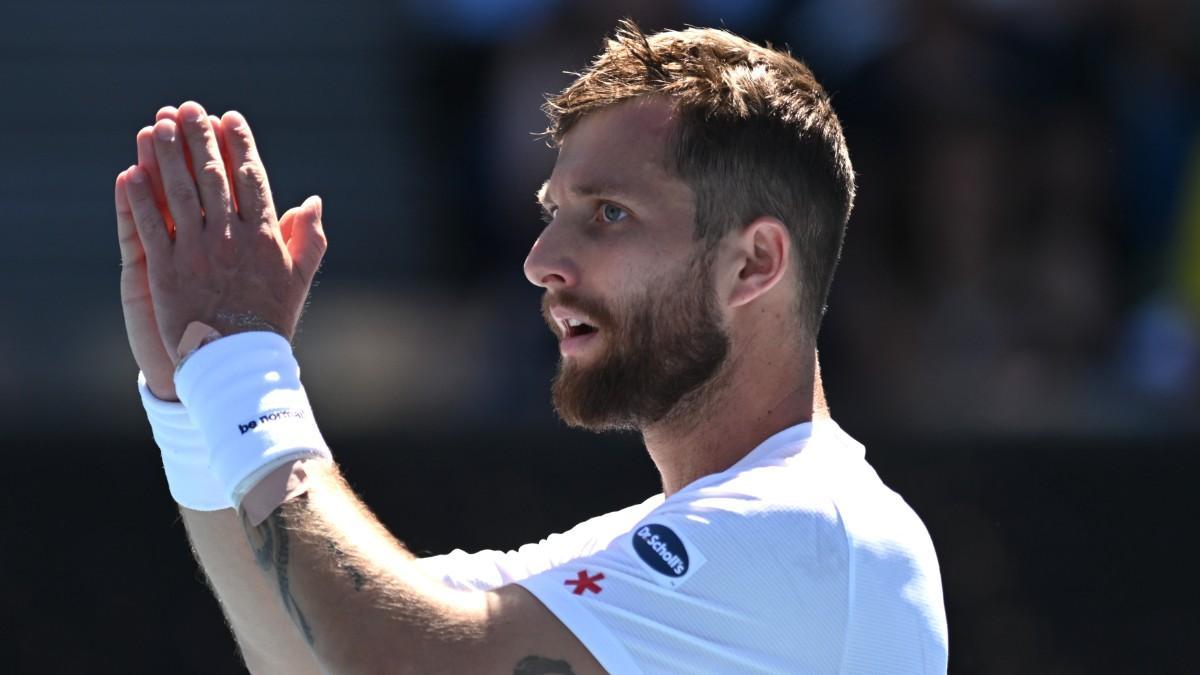

Corentin Moutet wants to leave broken rackets and on-court outbursts behind, but he cannot. He simply does not know how. “When I lose a set, it’s so hard for me. I don’t know how not to break a racket. That was always a big struggle with my coaches” admitted the world No. 40.
In an interview with former player Caroline Garcia on her podcast, the Frenchman opened up like rarely before, explaining the reputation for smashing rackets that has followed him throughout his career. “I never understood why you become the bad guy if you’re mad when you lose. For me, the strange guys are the ones smiling after they lose” he said on The Tennis Insider Club.
Moutet reflected on his career, explaining that many of his behavioural issues on court began, surprisingly, because he won so much as a junior.
“From the age of seven until I was about 16, I barely lost a match—maybe 10 a year at most. So I never learned how to lose. For a long time that was very hard for me, because when things started going badly, I didn’t know what was happening. The reality is that, at some point, you’re going to lose. Then you’re going to lose again, and again, and again. Nobody ever told me that” he admitted.
Moutet’s unconventional style has often frustrated tennis traditionalists. His underarm serves, emotional outbursts after defeats and the probably hundreds of rackets he has broken have made him one of the tour’s “bad boys”, alongside Nick Kyrgios and Alexander Bublik.
“I always felt people were telling me that who I am wasn’t the right way to behave. But that’s also what made me special. At the same time, they make compilations of me and say it’s funny, entertaining and that I should stay the way I am. Then they destroy me for who I am. It’s hard to know what people really want” he explained.
For Moutet, part of that stigma comes from the French media. “In France, the media are the sickest media in the world. One day you can be like a god and the next you can be the worst tennis player ever. When I lost, I got so mad that the next day everybody was talking about how I behaved. I don’t know how to lose, and people start to think you’re a bad guy. The pressure maybe comes from them” he said.
However, the 27-year-old’s struggles were not confined to the court. Coming to terms with the realities of the tour’s media and commercial world was another challenge he found difficult to handle.
“When I arrived on tour, suddenly there were media, sponsor events and you had to smile and say your racket was the best racket. It didn’t make sense to me. I was thinking: ‘Is this The Truman Show? Are we all acting?’ I felt like I was just an actor in this world. Nobody teaches you that. You have to learn it by yourself,” he told the former world No. 4.
Moutet also admitted that, although the journey is still a long one, he is now in a much better place than he was a few years ago and hopes to find peace amid the chaos of professional tennis.
“I still have so many things to learn, and I’m still not happy with the way I play tennis. It’s still painful, and I want to find peace in my game before I stop,” he said.
It was a side of Moutet rarely seen in public—more honest and composed, far removed from the chaos he often displays on court. He is searching for peace in a season without major results. He believes he is closer than ever. Perhaps that could prove to be his greatest victory of the year.