


PARIS – A dream come true: Alexander Zverev won the Roland Garros title on Sunday, lifting his first Grand Slam trophy – a goal he had pursued for years and which he once thought he would never achieve. But, now a champion, a new question faces the German: will he manage to be a popular champion?
On a lovely, sunny spring afternoon in Paris, the world number three defeated Italy’s Flavio Cobolli, the number 14 in the rankings 6-1, 4-6, 6-4, 6-7 (5-7) and 6-1.
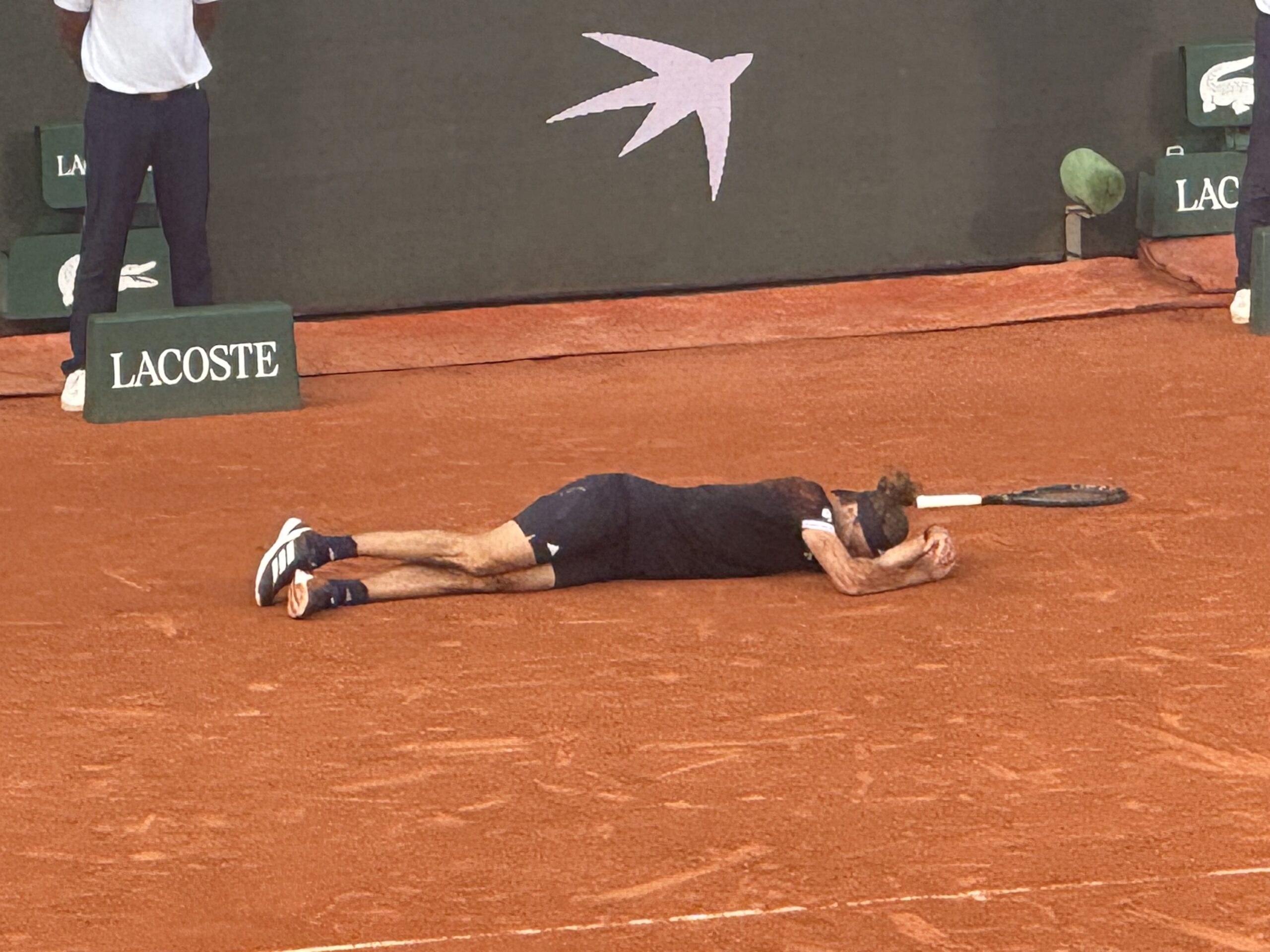
“I’ve had the best moments of my life on this court and I’ve had the worst moments here,” said Zverev after the final, pointing to the spot where a fall had knocked him out of his match against Spain’s Rafael Nadal in 2022.
“I think the spectators spurred me on throughout these two weeks, thank you very much,” he added, before dedicating some emotional words to his coaching team, family and friends.
“We’ve been through all sorts of moments, but in the end we’re Grand Slam champions!” said the 29-year-old German, who had lost the three Grand Slam finals he played before the one that gave him victory in Paris.
It was a final in which Cobolli, in the most significant match of his life, made too many errors. The Italian has good shots, energy and character, but he must still refine his game to see whether he will have opportunities like this again or become the successor to Mikael Pernfors, the Swede who, 20 years ago, surprisingly reached the Roland Garros final and never again achieved a similar impact.
Even so, Cobolli had chances to win, as he showed flashes of brilliant tennis that put him in strong positions. But just as he gained those advantages, he also squandered them. Or, as also happened, Zverev raised his game precisely at those moments.
“If anyone asked me who deserved this title, I’d always say you. I’m happy for you, but also sad, because I was close and I felt it. Let me win next time,” Cobolli told Zverev in an emotional speech after the final. “This is just the beginning, I’m young,’” he consoled himself.
Watched from the stands by Adriano Panatta, the last Italian champion at Roland Garros in 1976, Cobolli proved capable of the best and the worst in a matter of seconds, yet was undeniably entertaining and charismatic.
Panatta presented the winner’s trophy to Zverev, who is today a far better player than Cobolli: more complete, with more resources, more patient, more intelligent.
But the Italian has something that the German is consistently denied: the favour and sympathy of the crowd. Zverev is not liked; this was evident again on Sunday at the Philippe-Chatrier stadium, and the question is whether that will change now he has attained the undeniable status of a great champion.
In the run-up to the final, a barrage of social media posts recalled the two allegations of domestic violence levelled against the German by two former partners. One of those cases was settled with an agreement whereby the tennis player paid a fine of €200,000, without his guilt or innocence being established.
Zverev does not win any favours with his comments either, which combine the arrogant with the baffling. One of his latest remarks, after reaching the final, earned him the disapproval of more than one tennis player: he said that top-level athletes have nothing in their heads.
What the German is essentially trying to do is use irony to be funny, but it is almost invariably confirmed that he is a far better tennis player than a joker.
Beyond this, Zverev’s title dusts off some long-standing statistics: one has to go back 30 years, to the 1996 Australian Open, to find a German winning a Grand Slam title, in that case Boris Becker.
And you have to go back 89 years, to 1937, to find a German lifting the Roland Garros trophy, Henner Henkel.
With his success at the Bois de Boulogne, Zverev also ended a run of nine consecutive Grand Slam tournaments won by the duopoly of Italy’s Jannik Sinner and Spain’s Carlos Alcaraz. The last Grand Slam champion outside the ‘Sincaraz’ was Serbia’s Novak Djokovic, at the 2023 US Open.