

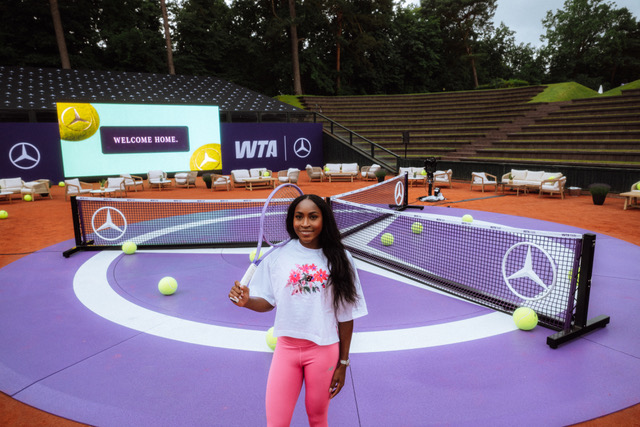

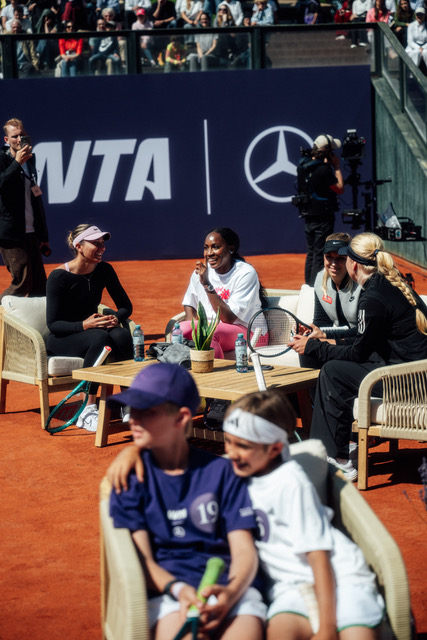
BERLIN – The Berlin sky could not quite decide what it wanted to do. The rain came and went on a last Saturday afternoon, but Coco Gauff never lost her smile. A few days before beginning her campaign at the Berlin Tennis Open, one of the strongest WTA 500 events on this years calendar, the American had a different kind of appointment. At the historic TC 1899 e.V. „Blau-Weiss“, just a short walk from the tournament grounds at the LTTC „Rot-Weiß“ Berlin, Gauff joined fellow players Paula Badosa and Clara Tauson for a special fan activation organised by Mercedes-Benz, the new global partner of the WTA Tour.
The setting was unusual: a triangular hard court, three nets, three players and a format called “Three Out”, inspired by the increasingly popular „One Point Challenge“. At first, Gauff appeared slightly puzzled by the unusual rules and the strange geometry of the court. But once she understood the tricky format, she embraced it completely, laughing and competing alongside amateur players, including many children from the club.
It was not grass. Yet everything around Gauff in Berlin was already pointing towards the grass-court season and, above all, towards Wimbledon. There is perhaps no tournament more closely connected to her childhood dreams.
“Every Grand Slam has been important to me. Obviously, Serena and Venus have both won that tournament many times. It was always a tournament I watched growing up and one that I dreamed of winning. And it’s still a tournament I hope to win”, she said in Berlin.
For Gauff, Wimbledon is not simply another Major. It is where the stories of Serena and Venus Williams became part of her tennis imagination. Serena, in particular, shaped the path that eventually led a young girl from Florida to pick up a racket.
“She’s definitely one of the main reasons why I decided to play tennis,” Gauff told the media in the German capital. Now, years later, Gauff is no longer the teenager who stunned the tennis world by defeating Venus Williams on Wimbledon’s Centre Court in 2019. She is a two-time Grand Slam champion and one of the leading figures of her generation.
Her own journey to this year’s Wimbledon, however, comes after a challenging first half of the season. The former World No. 2 has dropped to No. 7 in the rankings and is still searching for her first title of the year. Her Australian Open campaign ended in the quarter-finals, while her Roland Garros run was cut short by an unexpected loss to Anastasia Potapova.
“I think I wasn’t aggressive enough in that match. Sometimes you lose matches like that. Maybe if I had won that match, I could have gone even further in the tournament. But looking back, I think the main issue was that I simply wasn’t aggressive enough.”
Grass has never been her most successful surface. Despite all her achievements, Gauff has never gone beyond the fourth round at Wimbledon. This summer could be different.
And there is another storyline that could make the weeks ahead even more special. Serena Williams, the player who inspired Gauff to pick up a racket, is back in the business and also back in Berlin, teaming up with Karolína Muchová in doubles. The prospect of sharing a court with her childhood hero is something Gauff admits she has already imagined.
“I’m hoping that one day she reaches out to me to play doubles. That would be really, really special. And if she were to compete in singles, it would also be amazing to step on court with her, just because she’s a legend and someone I looked up to. I’m really excited to be in the same spaces as her again.”
But Gauff’s influence goes far beyond her own results. During the French Open, Clay reported exclusively on controversial comments made by Paraguayan player Adolfo Daniel Vallejo, who suggested that a difficult match atmosphere required a male chair umpire. When asked by CLAY in Berlin about these comments made at Roland Garros her response was direct: “I mean, obviously I am a woman in sports. I think an umpire’s job doesn’t depend on their gender. I was disappointed when I heard that.”
The same willingness to speak about broader issues in tennis also applies to the debate around prize money. Wimbledon this year has significantly increased its prize fund, but Gauff believes the sport still has work to do. “I think it’s still a long way. We are grateful about the progress that has been made. But there is a lot more that we can do, not only at Wimbledon but at the other Grand Slams as well”, she told CLAY.
At 21, Coco Gauff no longer walks in Serena Williams’ footsteps. She has created her own path. But Wimbledon remains the place where her journey began — and perhaps the stage where the next great chapter could unfold.