

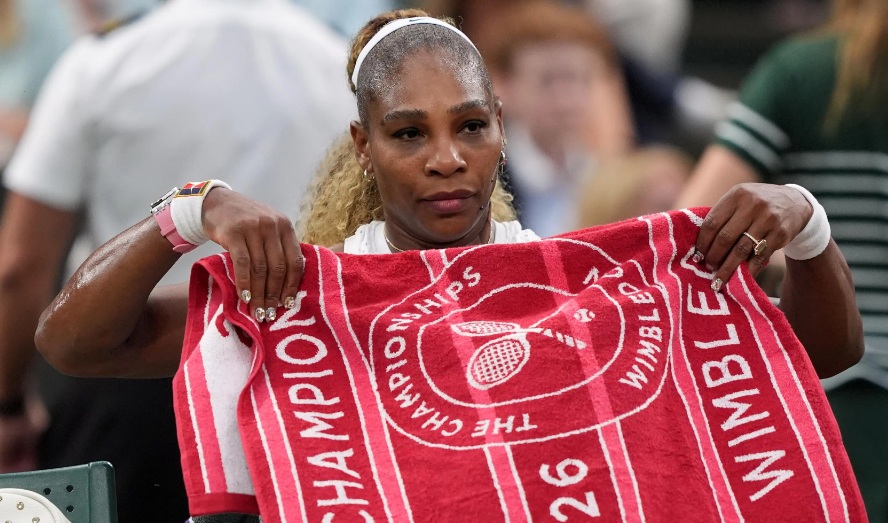

LONDON — Serena Williams leaves London with the bitterness of a comeback far more gruelling than she had surely imagined: defeat, injury, withdrawal and a wave of criticism.
The final chapter of the first season of her return to the sport ended badly, with a withdrawal from the doubles draw and a troublesome right knee.
Wimbledon made every effort to wait for her and give the champion of 23 Grand Slam singles titles and 14 in doubles enough time to recover and take the court alongside her sister Venus.
Tournament director Jamie Baker acknowledged as much, as reported by The Mirror: “We are giving her all the time she needs. Obviously, we want them to play if they can. Regarding the match days, it’s just a guideline. That’s what we hope to do, attempting to complete the tournament. Occasionally, exceptional circumstances arise, such as weather or injuries, or when a player participates in multiple events. It doesn’t happen often, but sometimes a match may be postponed.”
All women’s doubles first-round matches were supposed to be completed by the end of Friday’s play.
There were even players in the doubles draw already in the third round while the Williams sisters, scheduled for the last slot, still had no court assigned for their match against the Argentine-Colombian pair of Solana Sierra and Camila Osorio.
They were accused of receiving preferential treatment, and tennis fans engaged in an intense debate. Some found it unacceptable; others argued that legends like Williams deserve every consideration they need.
Wimbledon waited for her until the very last minute… Serena Williams is out. pic.twitter.com/ZvYWgbSZtl
— Clay (@_claymagazine) July 4, 2026
Williams’s knee did not hold up, and on Saturday afternoon the seven-time Wimbledon champion announced her withdrawal.
“I’m heartbroken to have to withdraw from doubles. Coming back to compete again has been a gift, and the opportunity to play alongside Venus once more meant the world to me. I did everything I could to be ready, but unfortunately my knee just isn’t ready to compete,” she wrote on her Instagram account.
In the carousel of photos and videos accompanying the announcement, Williams shared uncomfortable images of syringes containing the yellowish fluid drained from her knee: “The fluid they drained from my knee after my singles match… The good news is my knee shouldn’t swell or collect that much fluid again.”
An odd choice of image — as if wanting to present the evidence.
Williams drew a wave of criticism on Tuesday when she did not attend the press conference after losing in the first round of singles to Australian Maya Joint. That evening she gave no reason for her absence to the media, which did not go down well from any angle: the tournament’s guest was failing to meet one of the minimum requirements expected of every competitor. She left in complete silence. The following day, she cited medical reasons for her absence.
Added to that were negative reactions to her handshake at the net with her opponent: cold, distant, and without dedicating much attention to a young player living the most important moment of her career.
Her return to Centre Court against an opponent 24 years her junior followed the logic of what was foreseeable for a player who had been retired for four seasons, returning to compete at 44 without much preparation: mobility difficulties and unforced errors from the lack of match practice.
Her former physiotherapist had warned CLAY as much: “The reality is that I can’t picture her competing at the same physical level as when she was competing before her pregnancy.”
That Williams pushed the match to a third set is explained by the fact that her powerful tennis remains among the most damaging on tour, her serve is devastating, and she has more than enough experience to win the mental battle against an inexperienced young player facing that level of pressure for the first time.
And because she is one of the greatest players of all time: she did not win everything she won for nothing.
But a defeat it was, regardless her colleagues believing she was capable of going far and imposing her legendary status.
Following a storm of criticism on social media, her coach, former Australian player Rennae Stubbs, felt compelled to defend her: “The hate and lack of empathy in this world is astounding to me. Especially when you have no idea what you’re talking about. Just blows my mind.”
“Success is just enjoying myself,” Williams told BBC Sport at the All England Club before the tournament began.
Williams left Centre Court beaten by a player who had not won a match since early in the year; she was criticised for her attitude after losing, and spent long hours with doctors, deep in the uncertainty of whether she would be able to complete the comeback she had planned. It is not easy to enjoy yourself under those circumstances.
There is no way to be successful like that.