

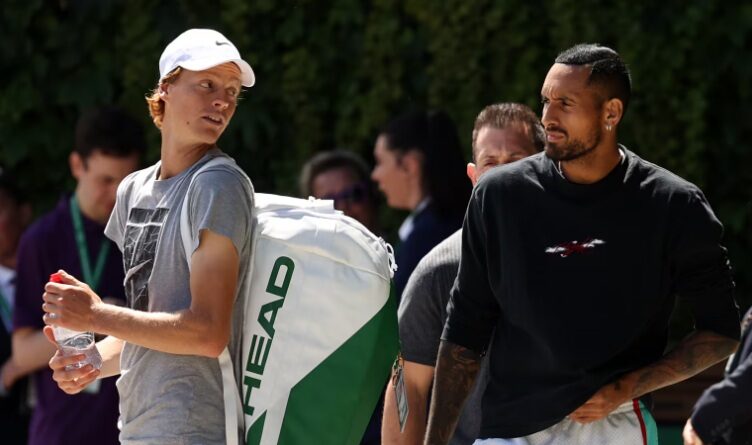

There is something particularly cruel about the timing of the blow that has hit Nick Kyrgios. Not because the Australian is not responsible for what happened — he has himself acknowledged the positive test for cocaine and publicly accepted his mistake — but because tennis has held up a mirror to him just as his career appears to be approaching its end.
Kyrgios had been talking about doping for years, with a forcefulness that, as is so often the case with him, frequently went well beyond what was prudent. He did it with Jannik Sinner. He did it with Iga Swiatek. And he did it with Simona Halep. Now it is he, at 31 and after several seasons largely wiped out by injuries, who has tested positive.
Halep’s reaction was not long in coming. “Never kick someone when they are down. Life has a strange way of switching positions. And an even stranger way of revealing the difference between an accident and a choice,” wrote the Romanian, a former world No. 1 and two-time Grand Slam champion. She did not need to name him. Everyone knew who it was aimed at.
In September 2023, after Halep was handed a four-year suspension for testing positive for roxadustat (a substance that artificially stimulates the production of red blood cells and EPO), Kyrgios waded deep into the debate over anti-doping controls. Some players had explained at the time that they were afraid to take even supplements or drinks for fear of testing positive. Kyrgios offered a much simpler recipe: his fuel for five-set matches was “banana and coke.” “Maybe players should stop taking dodgy shit, look themselves in the mirror and be able to say they’ve done the right things. It’s not complicated,” he wrote in that same 2023 tweet.
Ehhhh not really lol, I run on bananas and coke cola in 5 set battles. And my record in them speaks for itself. Maybe players should just stop taking shady sh*t 😂 look yourself in the mirror at the end of the day and say yep I did it right. Not hard.
— Nicholas Kyrgios (@NickKyrgios) September 14, 2023
And he went even further. In response to a user who challenged his comment, he replied: “I’d imagine if I was taking similar things to be banned for 4 years I’d have about 5 slams.”
But there is another quote that is even more significant. In August 2024, when Jannik Sinner was cleared at first instance following his two positive tests for clostebol, Kyrgios called for him to be suspended for two years: “Ridiculous whether accidental or planned. You test positive TWICE to a banned substance … you should be gone for 2 years.” And when a user reminded him of his own situation, came the response that has now become a perfect boomerang: “At least I’m clean, you potato.”
At least I’m clean you potato
— Nicholas Kyrgios (@NickKyrgios) August 20, 2024
Clean. A seemingly innocent word that, viewed through today’s lens, carries a lot more weight.
Because a few months later Kyrgios once again went after Sinner and Swiatek. In December 2024, he described it as “disgusting” for tennis that two world No. 1s had tested positive and said the integrity of the sport was “awful”. He also insisted that he would never resort to doping to speed up a recovery, precisely when he had spent years trying to return from his injuries.
Two years later, it is his own positive test that needs explaining.
A positive test for cocaine is not the same as the cases involving Sinner, Swiatek or Halep. The substances, circumstances, nature of the violations and potential sanctions are very different.
Cocaine is included on the World Anti-Doping Agency’s (WADA) list of prohibited substances as a substance of abuse and is prohibited in competition; the system also provides for different sanctions when use outside competition is established. In Kyrgios’ case, the sample was taken on June 22 during the ATP 250 in Mallorca, and his provisional suspension began on August 4, after an accredited laboratory confirmed the presence of benzoylecgonine, a metabolite of cocaine.
That matters. Because the positive test does not automatically allow Kyrgios to become what he himself accused others of being. But neither does it erase what he said. That is the real problem for the Australian.
Because the issue is not simply whether he took cocaine. He has said himself that he did. Nor is it whether he took it to improve his performance: there is no basis for claiming that, and it would be irresponsible to present it as fact. Cocaine is a stimulant and can produce effects such as increased alertness and a heightened sense of confidence, but that does not prove Kyrgios used it with the intention of improving his sporting performance. In Mallorca, in fact, he lost in the first round in straight sets.
The problem is something else. It is the distance between the Kyrgios who demanded certainty and punishment for others and the Kyrgios who now asks for his own circumstances to be understood.
In his statement, the Australian explained that the injuries, the years spent almost entirely on the sidelines and the feeling that his career was coming to an end had taken a huge physical and mental toll. He apologised to his fans, his family, his sponsors and, in particular, to the children who look up to him. He described it as a “huge mistake” and a “wake-up call”.
Kyrgios, at least for now, is not trying to convince anyone that the positive test did not happen. He has not appealed the provisional suspension. But it is impossible not to remember his own words. “At least I’m clean.” Not anymore. Kyrgios has gone from being the scourge of dopers to testing positive himself. He has ended up placing himself exactly at the centre of the issue he spent so much time talking about.