


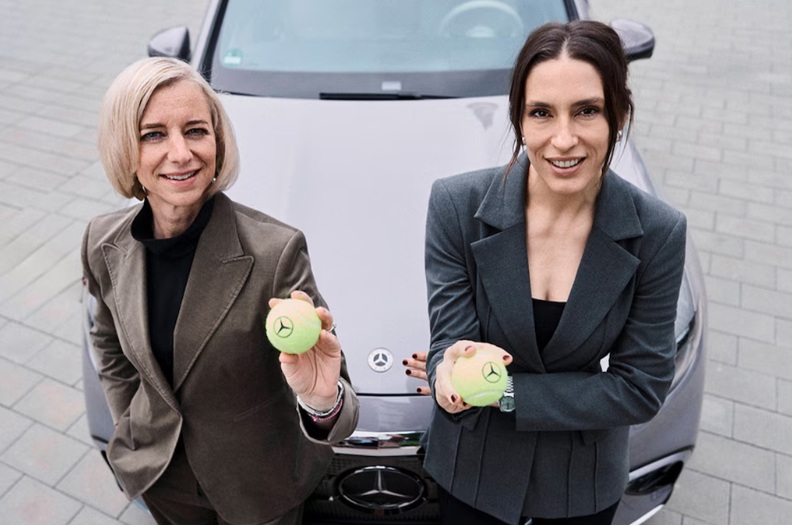

Mercedes-Benz has launched one of the most significant sponsorships in international women’s sports by becoming the “Premier Partner” of the WTA Tour. But the company aims for more than logos on nets and vehicle fleets at tournament sites. At the center of the partnership are the personalities who shape the sport.
The numbers alone tell part of the story: Mercedes-Benz will be present at roughly 30 tournaments this season, spanning the WTA 1000, 500 and 250 levels, with an expanded footprint planned from 2027. But for Christina Schenck, Vice President Digital & Communications at Mercedes-Benz, the scale of the deal was never the point. “It’s about far more than classic sponsorship,” she told CLAY. “We want to build a partnership with the WTA that takes place at eye level. It’s about creating formats that bring people together — players, fans, as well as existing and potential customers.” Tennis, she argues, has a rare connecting power, and that is precisely what the brand is betting on.
That philosophy explains why Mercedes-Benz has chosen to build the partnership around athletes rather than advertising boards alone. Coco Gauff has become its most visible face, and this year the brand added a second ambassador: Andrea Petković, the former world No. 9, whose relationship with Gauff goes beyond marketing. “If I were a brand, Coco would be number one for me — not only in women’s tennis, but in tennis in general,” Petković said. She points to an activation the two worked on together on the Signature Court in Berlin as proof of what makes Gauff so effective as a brand ambassador: “I was impressed by how naturally she interacts with fans and how open she is to everything. You suggest something — and she just goes along with it.”
Schenck describes the same instinct from the corporate side of the partnership. Mercedes-Benz, she told CLAY, wants to talk about what drives its ambassadors and how they can serve as role models, “especially for young women.” It is a deliberate shift away from static branding toward something closer to storytelling — and Wimbledon offered no shortage of material.
The dominant topic of the tournament’s first week was the comeback of Serena Williams, and Petković, working courtside as a broadcaster, watched its impact up close. “I actually see the comeback only in a positive light,” she said.
“I was in Berlin when she played doubles. The stadium was completely sold out. Here in Wimbledon I commented on her match — and the media frenzy was incredible. Alexander Zverev sat in front of an almost empty press room after his match because everyone was at Serena’s. Even many German colleagues were there,” the 7-time WTA champion said.
For Petković, moments like that reveal something larger about the sport’s growth potential: “Sometimes we think tennis is a huge global sport — and we are. But we can become even bigger. Players like Serena create attention far beyond tennis.”
Petković is always paying close attention to the action. Who caught her eye at Wimbledon 2026? “I immediately think of Arthur Fery and also Shintaro Mochizuki,” she told CLAY. “They have incredible vision, fantastic timing and show especially on grass that you don’t need the ideal physical prerequisites to be successful.” On the women’s side, she singled out Maya Joint — “she has fantastic vision, takes the ball incredibly early” — and Karolína Muchová, who she considers one of the most complete players on tour: “She can do everything — play from the baseline, go to the net, she has a good serve and is a true all-court player.”
For Mercedes-Benz, stories like these are exactly the point. Beyond the vehicle fleets and the branding at courtside, the partnership is designed to put moments like Petković’s read on the tour, or Schenck’s vision for the collaboration, in front of fans who might otherwise only see a logo. It is a bet that women’s tennis, told through the voices of the people living it, is the most effective platform the brand could ask for.