

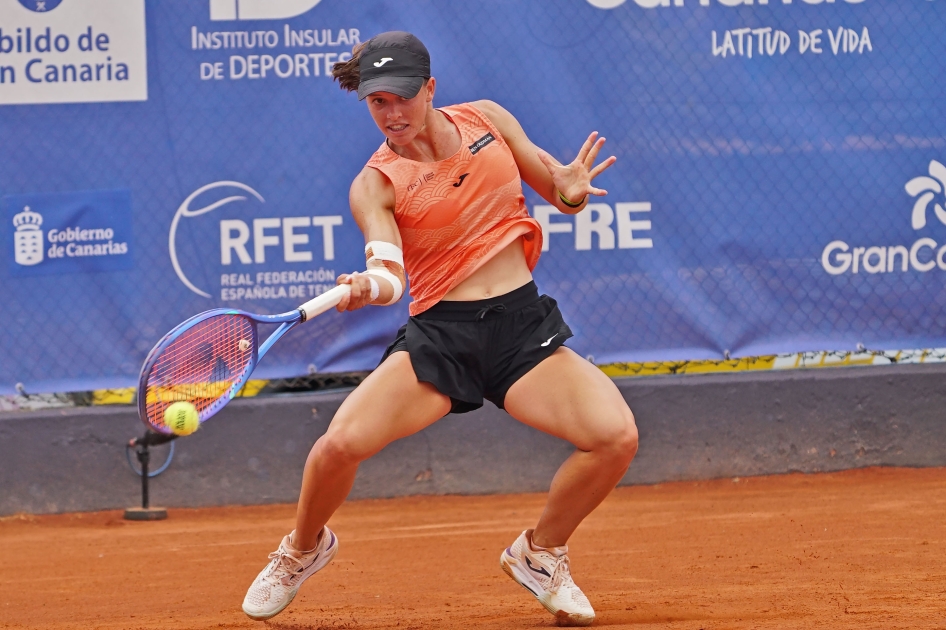

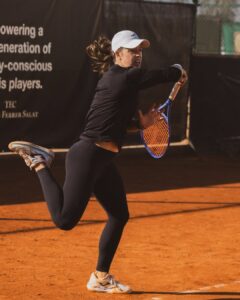
MADRID – The world’s top tennis stars do not take advantage of their influence and prominence to fight against climate change, wars, sexism, and social injustices. If you were asked to guess the age and profession of the person behind that statement, you likely wouldn’t choose the correct option: a tennis player who has just turned 20. But that is Kaitlin Quevedo, the young Spanish tennis promise who speaks loud and clear. “There is a lack of brave tennis players,” the world number 127 told CLAY in an interview.
Born in Naples, Florida, on February 13, 2006, Quevedo lived in the United States until, at age 17, she decided to settle in Barcelona and trade the Stars and Stripes for the Spanish flag. “It wasn’t a hard decision. I think when the opportunity arose and when the Spanish Federation showed their support and interest in me, I was clear about it,” she said.
Her progression—a year ago she was ranked outside the top 300—and injuries to several of her compatriots have placed Quevedo in a situation she still finds hard to believe: this Friday, she will be Spain’s number one in the Billie Jean King Cup tie against Slovenia. From the town of Portorož, on the shores of the Adriatic Sea, Quevedo answered CLAY’s call to talk about tennis, dreams, values, and injustices. “When I lived in the United States, I was already volunteering, doing things to help the community. It’s something I’ve been taught since I was little,” she noted.
Interview with Kaitlin Quevedo

– How does it feel to read and hear that Spain’s number one is Kaitlin Quevedo?
– It’s incredible. I don’t know, I didn’t expect it either. It’s a shame that Cristina Bucsa couldn’t come, but I am very happy to be here and I’m going to do the best I can. It’s a privilege to be here and represent Spain. So I’m very happy and full of desire and excitement.
– How was the first contact there in Slovenia?
– Good, good, adapting to the conditions. I think the ball bounces quite a bit. That suits me very well, and all of us. The weather is great, very sunny, we are very comfortable. And Portorož, where I’ve never been before, is very beautiful here by the sea.
– And what are Carla Suárez, your team, and your family telling you?
– Everyone tells me that I have to enjoy it to the fullest and try to enjoy everything I can in every moment, which in the end is the most important thing, no matter how it all turns out. And I’m sure I’ll leave with many experiences and many positive things, and I’ll come out of here as a better player and a better person. And I think that’s it, finding a bit of balance with all the emotions I’m going to feel this week here with the whole team. Because for me, in the end, it’s all new. It’s a bit about living with these emotions and managing them. But at the same time, enjoying being here a lot, being able to have this experience, learning a lot, and obviously enjoying it as much as I can.
Ver esta publicación en Instagram
– Do you usually get nervous or do you think you manage emotions well?
– In tennis there are many emotions, but I think that little by little, as I gain more experience and go through things like this, I manage my emotions better. I also learn much more about myself, how I am, how I feel at certain moments, and I suppose I’ll be nervous on Friday. It wouldn’t be normal, I think, not to be nervous. I’ll try to go in like any other match, let loose and play, because when I let loose I play really well. And also keeping in mind that I work very hard every day and that I also deserve to be here…
– Yes, it’s a reward too, isn’t it?
– Yes, I’ve earned it and in the end, I’m here for a reason. Keeping that in mind also helps, and when the nerves are there, it helps a bit to think about this. We’ll see on Friday, but I’m ready and it will also be a new experience. I think everything will be under control.
– You have the advantage of having Carla Suárez as captain, who has lived through many experiences like this. What is she conveying to you these days?
– Carla is incredible as a player and as a person; she has achieved so many things and she is here for us. She is helping us every day on the court, off the court, with everything. To be honest, what I like most about her is that she is very calm, but at the same time very competitive. I feel she will help me a lot in difficult moments or moments of tension. And these previous days she’s been telling me things, giving me tips, I feel there’s a good connection…
– And any specific tip that has stuck with you?
– Well, look, something that Sara [Sorribes] also told me, and we were talking about it this morning. She told me: “There will be a lot of noise, there will be a lot of things, but focus on your own thing, on Spain as a team, because we are all here to achieve the same goal and we will help each other.” That is, not letting outside things, the noise and everything, affect you. And trying to be like in your bubble.
– How would you introduce yourself to those who don’t know you, Kaitlin?
– Let’s see, I would say that on the court I am very competitive and very brave. And off the court, I am a fighter, hard-working, disciplined, and I also like to help others and be a good person; I am quite simple.
– And why did you live in the United States?
– I was born in the United States, in Florida, Naples, and I lived there until I was 17. Three years ago—now I am 20—I moved to Barcelona and started training at the TEC. But yes, I was born in the United States because my mother is American and my father is Canarian. So I’ve always had that Spanish part too, and we’ve also gone to the Canary Islands quite a bit to visit family, to be there on vacation. And I’ve always loved it.
– And was it a difficult decision to stop competing for the United States and compete for Spain?
– It wasn’t a hard decision. I think when the opportunity arose and when the Spanish Federation showed their support and interest in me, I was clear about it and I don’t regret the decision at all. I am very happy with the decision and obviously, it’s a pride to represent Spain and also to live moments like this week’s. Besides, I went to train in Barcelona. Everything makes more sense this way.
– You were talking earlier about being a good person, and I understand you care a lot about climate change, inequalities, feminism… Where does that critical thinking come from?
– There are causes that seem very important to me, like social inequalities and everyone having equal opportunities and everyone living well. That there are no injustices. And I’ve always had that awareness…
– That was instilled in you at home too, right?
– Yes, like I was raised that way too, but especially now that I am more mature and obviously you understand more things… Also, at the TEC they teach us many values and they teach us to be aware of what is happening in the world. It’s very important too because, in the end, as athletes, we have a platform to speak about these things and help certain causes. It’s something that seems very important to me and it’s always been something I’ve liked because even when I lived in the United States, when I wasn’t even at the TEC yet, I was volunteering, doing things to help the community. It’s something I’ve been taught since I was little, always.
– In that sense, it is often strange to see big stars raise their voices against certain injustices. They say “I play tennis, I’m not a politician, and I stay out of it.” Do you think that is a valid stance, or is there a lack of brave tennis players?
– I think so, that there is a lack of brave tennis players. In the end, there are many of us. Well, “us,” I’m not up there yet… But as an athlete, it seems very important to me because in the end you are a role model and many people follow you and you can really make a change, you can really help. And so, yes, it seems very important to me. In tennis, in the end, you are working all day to compete, to be the best, but there is also that part that I think is very important to at least be aware and try to help in your own way. There isn’t one specific thing; it’s about trying to do the best you can so we can all live in a better and fairer world. It’s true that there are many tennis players who in the end say they don’t want anything to do with politics and I understand it because it’s not easy either to put your opinion out there and have everyone judging you. So, well, I think there are both sides, but to me, it seems like an important thing to do your bit in doing what you can. You aren’t going to change the world, but you can do your part. And when those at the top have that loudspeaker and that strength… It’s an opportunity to do something. That is something they have taught us a lot at the TEC: do your part and do what you can. And in the end, maybe you don’t change it yourself, but with the help of other players, by being the first to say something or raise your voice, you can also make a change like that. In other words, it can’t just be from one person. It has to be from a group. We have to help each other.
– I understand you are a big fan of Rafael Nadal. Have you ever spoken to him?
– No, never. I’ve never spoken to him and I’ve never crossed paths with him. It’s a shame because I would have definitely taken a photo. But now, maybe we’ll see in the future if at some point I can meet him. It would be spectacular.
– What advice would you ask Nadal?
– It’s very difficult… I would ask him about the difficult moments or the days when you aren’t feeling well, which is something he was incredible at. How to get out of that and how to help yourself. And that mentality he has, so feisty. How to win on a bad day, which is something I still struggle with. And even training days too, how to get out of there. Because a bad day can happen in a practice, it can happen in a match, you never know. I would ask him how to manage that.
– And have you crossed paths more with Carlos Alcaraz, or not?
– No, I’ve seen him around at Grand Slams, but I’ve never spoken to him, nor high-fived him or anything. I mean, I don’t think he even knows who I am.
– Well, there’s time, there’s time. He will definitely know you after this weekend.
– Yes, yes, I hope so…