

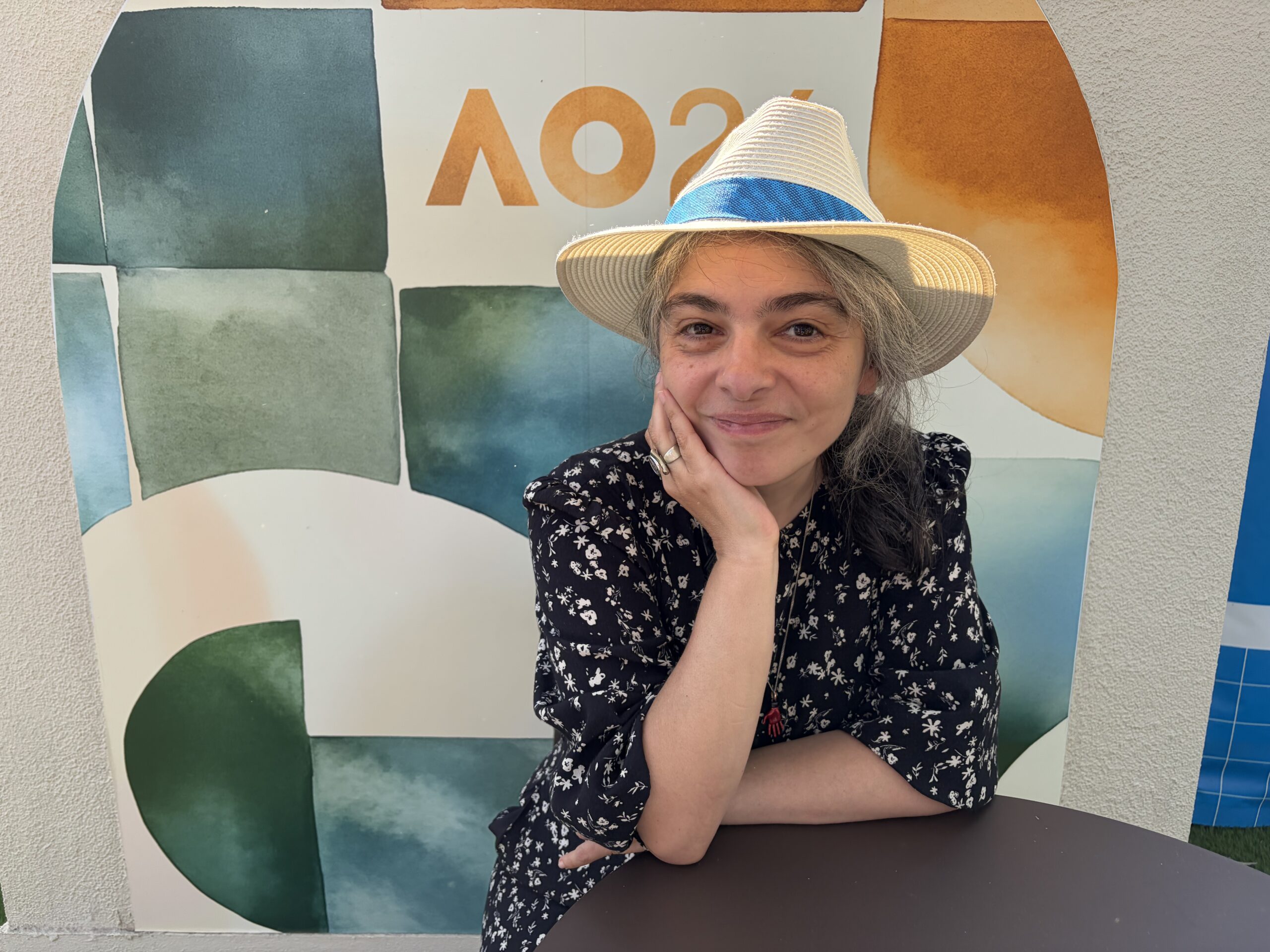

Argentine bestselling author Mariana Enriquez has long been obsessed with Novak Djokovic. In January, she finally watched him play live.
“Djokovic is like a difficult love. Everyone would like him to be less exasperating, more European, to say less of what he thinks. Just when he’s about to be crowned, he steps aside – I think it’s part of being the third and the best. He feels he’s never fully recognised, and I think he’s right,” Enriquez analysed with CLAY in an in-depth interview.
The journalist, winner of the 2019 Herralde Prize for her novel Our Share of Night, attended a Grand Slam for the first time in 2026. In Melbourne, she shared her views on her favourite player, tennis’s cultural shift, the new generation and social media.
“Novak is an adult in a children’s playground, and that’s becoming more and more apparent. The younger players don’t even get involved within the ATP — they have no interest in being on the inside, pushing things forward,” the author of Things We Lost in the Fire told CLAY.
Interview with Mariana Enriquez
– What did you make of the experience of watching a Grand Slam?
– I imagined it as smaller, less demanding. If you want to watch a match on the outside courts, you have to go two hours in advance and practically die under the sun. It’s the same with practice sessions – you have to be there all day. It’s like a pilgrimage to Luján: demanding, but in a good way. It’s brilliant.
– You were in that hell under the sun, but also in the front row at Rod Laver Arena to watch Djokovic.
– I had never seen him at a professional level, and Nole is at a point in his career where this could be his last Australian Open or he might keep playing for another five years – you just don’t know. So I said, if I’m going to see him, I’m sitting in the front row. Because it’s the first round, the ticket is expensive but not outrageous like in the later matches.
– Did it live up to your expectations?
– I went mad. He also played very well, so it felt almost like being in a cathedral. I love noise in tennis, but being there during those moments of silence, watching Nole play like that… it was mystical.
– David Foster Wallace said that watching Roger Federer was a religious experience.
– I never understood the frenzy around Federer. I understand the admiration, but not the passion. He seems so proper, such a good student, so predictable, in a sport that demands exactly that, that without any rupture he doesn’t excite me. The young Federer, who could be quite a bastard – that version interested me a bit more.
– Does Djokovic represent that religious experience?
– He’s like a difficult love. Everyone would like him to be less exasperating, more European, to say less of what he thinks. Just when Nole is about to be crowned, he steps aside. I think it’s part of being the third and the best. He feels he’s never fully recognised, and I think he’s right.
– Will that narrative ever change?
– It might, because once he’s no longer playing it will become a fascinating narrative, just like Rafael Nadal’s. In the end, Federer’s narrative is like that of a supermodel, a very elegant man. He’s an extraordinary player, but narratively Federer is more of an ambassador, and Nole wants to be Napoleon, not the ambassador.
– Will Djokovic, after retirement, be on a tennis court or operating on a more political level?
–He always says he doesn’t, but I think he has strong political ambitions — especially because he sees things aren’t working and wants to step in and fix them. I’m not sure how much support he would have, though, because my sense is that tennis isn’t in the best place to allow for turbulence, and if you let real politics in, there will be turbulence.
– Does he have a bad relationship with the tennis establishment?
– I don’t know what it’s like at the moment, but what’s very obvious is that he’s the record man who suits them least. They would rather all those records belonged to Nadal or Federer, so they could have spotless sponsorship around it.
– Beyond tennis, do you think he could become president of Serbia?
– Yes, of course – but let’s hope not (laughs). The thing is, he doesn’t speak very clearly about his political positions, and he hasn’t for a long time, but I sense he holds conservative views, and being an Orthodox Christian carries political weight in the Balkans. He’s careful about that because he’s very intelligent and knows what might clash. In 2008 he spoke about Kosovo’s recovery and that night there was a huge uproar. I think that’s when he thought: “be careful”. Except with Covid, where his stance – and his father’s – was very clear. I can’t see Uncle Toni saying “my nephew is a Spartacus” while Nadal is being held in a hotel with migrants. Federer detained in a hotel in Melbourne and years later saying they tried to poison him? That just doesn’t exist for the others.
– His childhood must have shaped his political thinking.
– These are heavy issues, and I think he’s speaking more about them now, but the elephant in the room is that NATO bombed Serbia because the Serbian government was committing genocide. Obviously, the Serbian people had nothing to do with that, but these are extremely complex political questions, where Serbia ended up as a stigmatised country, but also one where the government committed very serious acts.
– The decision to move to Greece was also political.
– There was a campaign to portray him as unpatriotic, an attempt to go after his father. It seems the Djokovics are quite protected by the public, because if an authoritarian government like Serbia’s wanted to expose and destroy him, it could. It seems it’s very unpopular to take him on. He took a tournament with him and won it – the others don’t do that. The feeling I’ve had about Novak for several years is that he’s an adult in a children’s playground, and that’s becoming more and more apparent.
– In what sense?
– An adult in the sense that he goes, does business, publicly supports his government and then has very strong clashes with them over the protests. He does a dance at Wimbledon, which he says was for his daughter, but we know it wasn’t – that’s what the students were chanting in the protests.
– The new generation never backed him in the PTPA, his main fight for the players.
– The younger players don’t even get involved within the ATP, which is quite striking. They’re not interested in being inside, pushing things forward. I see Zverev as the player who can have a dialogue with Djokovic, but he’s another player who isn’t well liked.
– Why?
— There’s the issue with the allegations of violence from his girlfriends, which cast a permanent cloud over him, but it’s also true that nothing was ever proven legally, and I don’t think the other young players are progressive enough to be deeply bothered by it.
– Is today’s tennis at risk of losing its more disruptive narratives? The Safins, the Djokovics…
– Safin is a character I don’t think could exist today. Neither Alcaraz nor Sinner are going to turn up to a court hungover, with two half-naked girls, and lose an Australian Open final. But I don’t want to sound like a bitter old woman, because it’s the same as with music. Things have changed, times have changed. Something very interesting now is that there are many very young players from countries where there used to be no tennis. The Alexandra Eala phenomenon is remarkable in every sense. Chinese players are also starting to become superstars. Zheng is one of the players with the most personality – she says, “I didn’t come here to make friends”, she breaks completely with everything.
– We’re entering a new era.
– Yes, because for example Tien is North American, but also Asian. You can already see a new world emerging, and that new world is different. Mirra Andreeva is Siberian, but she speaks incredible English at 18, and that’s because she’s a more global kind of player.
– Does Andreeva interest you?
– Yes, and it also strikes me that she has a female coach at this stage of her career, having already won two Masters 1000 titles, because women players don’t have female coaches.
– Do you have an explanation for that?
– I think something happens that you see with women in all more technical fields. For example in literature: there are many women writers, many women editors, but very few who own publishing houses. Also, many players, when they retire, have children, so it’s difficult. For men, having children isn’t something that keeps them at home. Why couldn’t Ash Barty be a coach? Let her husband stay at home.
– Any other players?
– I’m not a huge fan of the women’s game, but I think that’s more my issue. Sabalenka is a superstar, and if Paula Badosa didn’t have the problems she has, she would be as well – not just because she’s beautiful, but because she has something. Eva Lys has something too.
– How can tennis grow its audience?
– I think there’s room for these kids, who’ve grown up on TikTok, to build a relationship that’s partly about sponsorship and partly about showing themselves. Coco Gauff does it very well; Osaka is less active on social media now, but she does it well too. They become very privileged very early on, and it would be good for them to share that a bit more – what it’s like, how it feels. There’s a layer of hyper-fame that’s worth sharing, because it’s a world no one else lives in. When you’re 21 and you’re Carlos Alcaraz, it would be very interesting for him to talk about what he’s going through.
– Alcaraz doesn’t open up much.
– Social media has now become more about sponsorship, posturing, the algorithm. It’s very difficult for a professional tennis player to present themselves there in an interesting way.
– How complex is this new reality going to be for journalism and non-fiction?
– Managing the narrative is a relatively new issue – this idea of “owning the narrative”, which is closely tied to social media, where in the end you either get distorted or distort yourself. It’s not just happening in tennis. Beyoncé has been communicating with the press through her fans for 15 years; she’s a star who doesn’t give interviews. Taylor Swift makes a six-hour documentary and tells what she wants to tell, and there’s no access. For journalism, this is very complicated, and in that sense Djokovic makes a lot of noise. He’s someone who will give an interview and actually tell you things. With caution, but still – he’s someone who, as we were saying, has just had a public clash with his country’s president.
If you enjoyed this interview with Mariana Enriquez, don’t miss, at this link on our website, many more conversations with the leading figures in tennis.
Do you love CLAY? Support us on Ko-fi and follow us on Instagram, X (Twitter) and Facebook.