

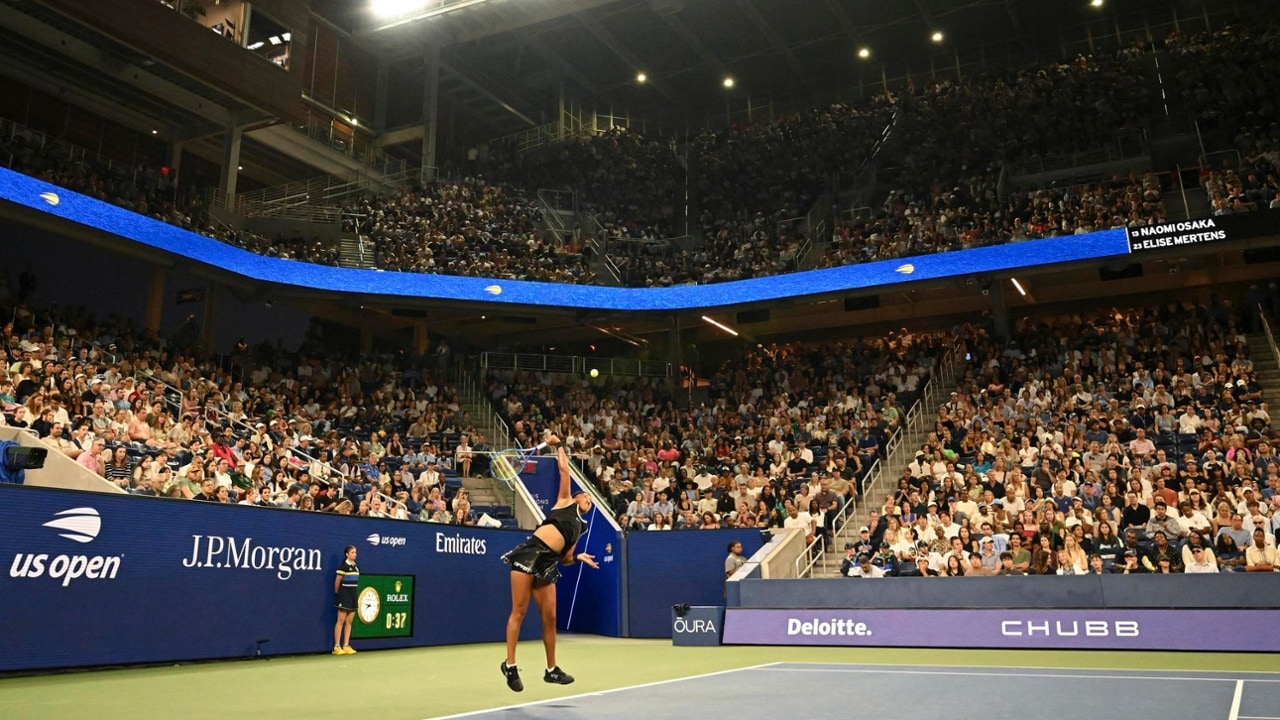

The commercial agreement between the US Open and betting company Kalshi puts tennis’ biggest contradiction on the table: why can tournaments receive money from an industry that players are prohibited from doing business with?
“Players can’t do anything with a betting sponsorship, but tournaments benefit from it. We receive a lot of negativity from bettors. We get a lot of hate on social media, so it’s hard to see them as sponsors,” said world No. 3 Jessica Pegula.
The ethically complex relationship between the American Grand Slam and the betting company — which both organisations rather elegantly define as a “prediction market” — has attracted worldwide attention, but it is far from an isolated case on tour.
Betway is an official sponsor of the Miami Open, Betsson of the Davis Cup and Bwin of the Halle ATP 500. 1xBet has gone a step further, with not only a commercial agreement with the Billie Jean King Cup, but also a major deal with the Challenger Tour, appearing as a partner at 36 events across the circuit.
“We need to look at how to regulate that betting in tennis, but it’s almost impossible because most of the major sponsorships at some tournaments come from betting companies. It’s tough,” Chilean Alejandro Tabilo told CLAY at Roland Garros.
Kalshi’s logo does not just appear on the tournament’s courts; the official US Open app has also made sure it reaches fans’ phones through push notifications promoting match predictions.
The USTA defended the agreement, but also indirectly acknowledged the problems a relationship of this kind could create.
“The USTA and Kalshi have established a comprehensive integrity framework for the US Open, designed to protect competitive fairness in an evolving market landscape. Under the agreement, markets that present an integrity risk — such as umpire decisions, player injuries and code violations — will be restricted,” they explained in a statement.
They also announced an agreement with the International Tennis Integrity Agency (ITIA), the same organisation that prohibits players from entering into commercial agreements or appearing in advertising related to betting.
“Kalshi has also executed a confidential data-sharing agreement with the International Tennis Integrity Agency (ITIA) for real-time market surveillance, complementing the USTA’s multi-layered strategy of proactive monitoring, stakeholder education and strict compliance enforcement,” they added.
In a 2022 interview with CLAY, Taylor Fritz criticised the fact that, within the tennis ecosystem, players are the only ones who are not allowed to make money from the betting industry.
“Everybody in tennis is making a profit off of betting, except for the players. We get all the harassment from betting. We get 50 to 100 death threats after every match you lose. Awful messages, all the hate and all of the negative side of gambling, but we don’t get any of the possitives. It’s unfair to us. By no mean tennis players should tell people to bet on tennis, but I don’t think it should be a problem when is something outside of tennis,” the norteamerican said.
This issue and its contradictions are not unique to tennis. The expansion and increasing complexity of modern betting have forced most sports to confront the same dilemma.
The NBA, which has commercial partnerships with FanDuel and DraftKings, prohibits its players from betting on the league, the WNBA or the G League. When it comes to referees, the restrictions are even stricter: they cannot bet on any sport, they cannot enter casino gaming areas during the season and, during the off-season, they are also prohibited from physically entering the sportsbooks at these venues.
In the case of the world’s most prominent basketball league, the measures were tightened after referee Tim Donaghy was exposed in 2007 for manipulating and betting on games he officiated himself.
For tennis, stories like this are hardly unfamiliar. In 2025, the ITIA sanctioned 47 people — players, coaches and officials — for breaching the Tennis Anti-Corruption Program (TACP). So far this year, another 18 professionals have been added to the list, while six remain under investigation.
Amid all these proceedings, the US Open was negotiating a deal with Kalshi. Tennis’ biggest contradiction has never been more evident.