

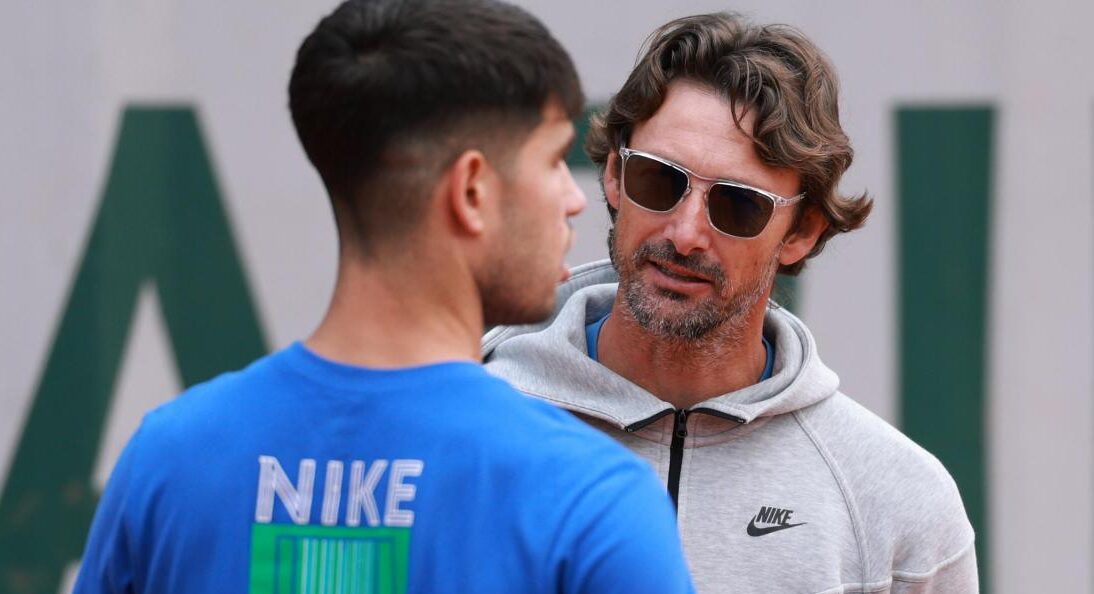

MADRID — In tennis, talent is the entry ticket, but without discipline it is impossible to transcend. Juan Carlos Ferrero, the man behind the early explosion of Carlos Alcaraz, offered a reflection that sharply dissects the difference between being a great player and becoming a legend. For Ferrero, success is not a state of mind, but a habit that must be nurtured in different ways, especially when passion begins to fade.
The former coach of Alcaraz has a clear thesis: motivation is a finite resource. At the start of a career, the adrenaline of the first Grand Slams and the climb up the rankings act as seemingly endless fuel. Everything is new, everything pushes you forward. But the professional tour is also a grinder. After several years — especially when you are at the top — the shine of novelty begins to wear off. That is when everything becomes routine, when many stagnate, when many stop growing.
“Alcaraz can be one of the best in history. In terms of results, he is already breaking many records. He has the tennis, the physicality and the mental strength. The only thing that could stop him would be losing motivation, something that can happen when you start so young. I’ve always told him that when motivation runs out, discipline has to take over,” Ferrero said in an interview published this Friday by El País. “As long as he keeps enjoying himself and playing the way he is now, he will have a very long career.”
It is the same message Ferrero delivered a few weeks ago when he appeared on La Sexta, one of Spain’s main TV channels. “When motivation disappears, discipline has to appear,” he said in that interview, just after being asked whether Alcaraz will become the player with the most Grand Slam titles in history.

“I would love that,” Ferrero replied immediately. “I have always thought — and tried to convince him — that he could be one of the best in history if he truly works well, and once motivation fades, discipline must come in strongly. It’s very important.”
Ver esta publicación en Instagram
The former world No. 1 and 2003 Roland Garros champion expanded on that idea. “At the beginning, when everything is new, motivation is up here (placing his hand high), your first Grand Slam, your second, your first year… But once you’ve been on tour three or four years, discipline has to appear. You have to truly understand the path you need to follow, know yourself perfectly, work, work and work when you need to, in order to stay at the level you want when motivation drops a bit.”
At that point, he brought up Novak Djokovic as an example — the record man, statistically the most successful player of all time, still competing with the best in the world as he approaches 39. In a tennis landscape dominated by the young Jannik Sinner and Alcaraz, the Serbian represents resistance.
“Novak, for example, has done it very well. If you ask him, he won’t be as motivated now as he was at 23 or 24, but the discipline he shows in tournaments — the way he takes care of himself, the way he does things, the way he trains — it’s very clear what needs to be done.”
Ver esta publicación en Instagram
“Djokovic and Federer were technically better than Nadal”
At that point in the interview with La Sexta, Ferrero praised Djokovic before offering his view on the Big Three. He highlighted the artistry of Roger Federer in constructing points, Djokovic’s solidity, and Rafael Nadal’s ability to adapt to any environment.
“I’m a fan of Djokovic. I love, first of all, the way he plays — he strikes the ball so cleanly, I’m always mesmerised watching him. In terms of numbers, he’s the best, although it comes down to taste. I’ve always personally preferred Roger, for his style, the way he hits the ball, the way he constructs points — to me he’s a point artist. Novak is more solid, more rock-like. He doesn’t have that dynamism Roger had, where in the same rally he could hit a drop shot, then a lob, come to the net, stay back, defend and then attack you at the end. Novak is more solid, he uses the opponent’s pace, then turns it against you — he punishes you, dominates you and moves you side to side,” Ferrero explained before moving into “Nadal territory.”
“Djokovic and Federer were technically better than Nadal. Roger, certainly, and Novak I would also say struck the ball more cleanly than Rafa. But Rafa had an incredible ability to adapt to the environment. If he might have been slightly below the others technically, he made up for it with his mentality. That helped him. Many times injuries didn’t respect him, but physically he was an absolute beast — and I think that helped him compensate for any shortcomings.”
Follow all CLAY stories on our Instagram, X (Twitter) and Facebook accounts.