


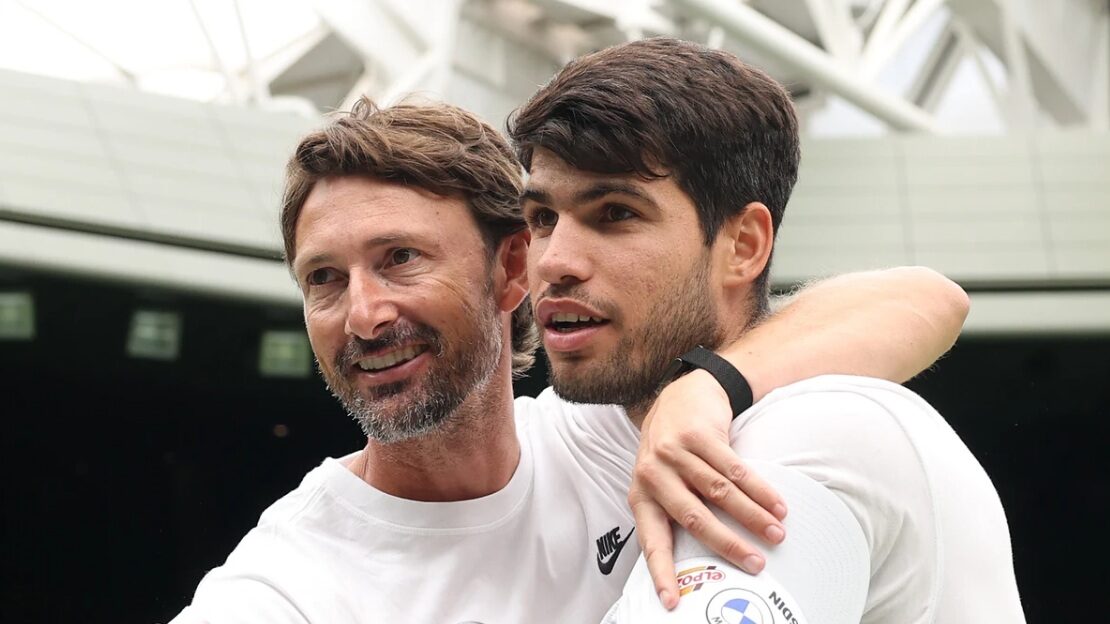

There is only one Uncle Toni, and not even Rafael Nadal was able to keep him on throughout his entire career. Players and coaches are doomed to part ways, to break off that strange relationship in which the theoretical sports boss is, in reality, the economic vassal. Carlos Alcaraz and Juan Carlos Ferrero were also unable to escape this reality.
Was it an agreed breakup? It was an agreed dismissal, as Ferrero made clear with that final sentence in the statement on Tuesday, 16 December 2025, an early Christmas present: ‘I would have liked to continue.’
A source very close to Alcaraz’s years of great success in international tennis told CLAY and RG Media: ‘There were significant disagreements between Ferrero and Alcaraz’s father about how to manage the player’s career.’
Javier de Diego, tennis specialist at Radio Nacional de España (RNE), added a key piece of information: ‘The relationship broke down two days ago when no agreement was reached in the negotiations for the new contract.’

One can read between the lines and recall some images, phrases and situations from recent years in which Ferrero was remarkably successful: not only did he lead Alcaraz to six Grand Slam titles and the world number one ranking, but he also put him on the path to becoming a legend.
Between the lines is Ferrero’s clear desire to have remained Alcaraz’s coach, and between the lines, too, one can read the player’s response: ‘I am left with the peace of mind of knowing that we have given our all, that we have made everything available to each other.’
Ver esta publicación en Instagram
Do they no longer like each other, have Alcaraz and Ferrero fallen out? Of course not, but Ferrero is a special Spaniard, a man of Scandinavian sobriety when compared to the exuberance of most of his compatriots. It is no coincidence that he never had a relationship with Nadal that went beyond correct.
Some images, memories and quotes can be recalled to better understand what happened.
Ferrero’s sobriety is incompatible with certain aspects of Alcaraz’s ‘showmanship’. That Netflix documentary, ‘My Way’, in which the player explained in detail his philosophy of tennis and life, with enjoyment as a priority, explains a few things.
And, in a recent interview in CLAY, former Brazilian tennis player Fernando Meligeni, who shared the circuit and friendship with Ferrero, gave some clues as to what ultimately happened.
According to the 1999 Roland Garros semi-finalist, ‘My Way’ implies more than Alcaraz’s declared taste for partying.
“It’s more than that. Let’s see. That “my way” is the schedule, it’s how much, it’s how. The truth is, the problem between the player and the coach is about commitment, how much you’re going to commit. Logically, the nightlife and the booze are one of the most important things. But then there’s everything else. How much is the family going to be involved? Alcaraz’s family is all in. Will Juanqui want Alcaraz’s brother to be on the team? I don’t know.‘
In that interview in September, Meligeni had no doubt who won the battle. ’It was won by “my way”. And today you have the kid [Alcaraz’s brother], you have the father.”
Ver esta publicación en Instagram
If it’s already difficult to coach a player, it’s much more difficult to guide a player with his whole family in tow, in this case his father and brothers. According to CLAY, Ferrero and Alcaraz’s father had a heated argument when the coach announced that he would not be going on the South American tour in February 2023 and that he was delegating that mission to his former coach, Antonio Martínez Cascales.
The youngster and the veteran did not do badly at all: Alcaraz was champion in Buenos Aires and runner-up in Rio, but the argument between the coach and the father would leave its mark. A year later, Ferrero was in Buenos Aires coaching Alcaraz, who lost in the semi-finals to Chilean Nicolás Jarry.
CLAY asked Ferrero the following question: ‘Alcaraz talks about what he needs to correct off the court, and last year you said that he needs to be more professional off the court. What do you mean by that?’
Ferrero did not shy away from the subject: “Understanding professionalism, when to really work, when to rest, when to be focused. That, for young people today, is really complicated, because it is often difficult for them to live the reality of their surroundings. They go from week to week, they are treated very well everywhere and they don’t see reality. In that respect, I think he is improving a lot. I think the team structure around him helps him to keep his feet on the ground.”
With the possibility of Ferrero leaving his position, Samuel López began to take on a more prominent role, accompanying the player to more and more tournaments. He was also the architect of the change in Alcaraz’s serve, a shot that has clearly improved today.
It became increasingly clear in recent months that Ferrero would not continue, with Alcaraz increasingly reluctant to drive an hour to train at the academy in Villena, an hour away from the Carlos Alcaraz Tennis Academy in El Palmar, a venture run by his father that the player is seeking to promote.
Ferrero – successful today, but who probably sees things in the future that no one else can see – was invited to jump ship at an intermediate port because, in the end, the issue was quite simple: who should adapt to whom; the number one to the coach or the coach to the number one? The obvious answer came nine days before Christmas.




2 Comments to “Chronicle of a breakup foretold: the reasons why Alcaraz fired Ferrero”
Joseph B. STAHL
Something about this isn’t right. I don’t mean that the breakup isn’t right, what I mean is that this whole idea of having a coach who is important in the first place isn’t right at all. I say this because for about the first hundred years of tennis history, players didn’t have any coaches, they just went out and played, and they were their own masterminds. This idea that a Svengali is needed to pull the strings in the background is a Millennial phenomenon of the Goofy Generation in which people no longer ever grow up. You can see this in the behavior of players on the court: they are constantly doing stupid, infantile things like cocking a fist, making a face and signaling that they want applause when they win a point, behaviors in which NO tennis player EVER engaged up to about the 1980s. Basically the players today are babies, who need babysitters. It strikes me as really stupid.
Sebastián Fest
Thank you for your comment! Some of what you mention is covered in an article published today: https://www.claytenis.com/analysis/alcaraz-murray-ferrero-australian-open/