

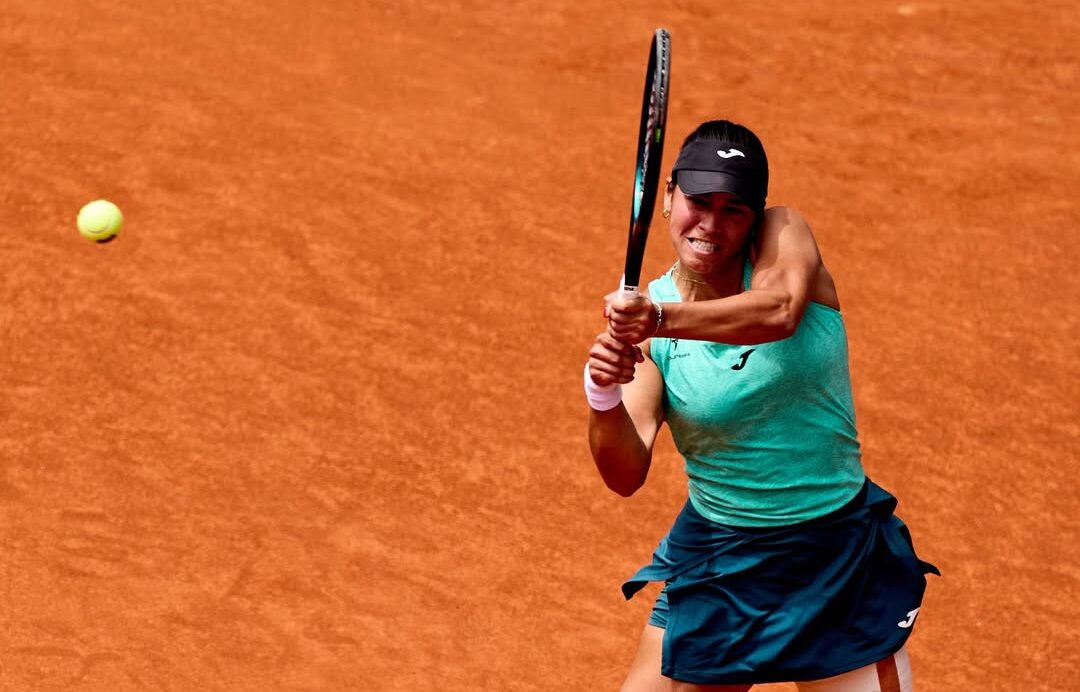

PARIS – The pace of a professional tennis player’s life—plane, hotel, match, practice, recovery, and start all over again—doesn’t offer much time to slow down and think about the journey. “I think all of us forget a bit to value where we are compared to where we have been,” Spanish player Jessica Bouzas said in an interview with CLAY at Roland Garros.
“A lot of people, not just me as a tennis player, surely you as a journalist too, value where they started and where they are. But the ambition we have makes us forget to value where we are. We always want more and more,” the WTA world number 50 added.
After months of significant instability, the 23-year-old Bouzas lands at Roland Garros with a massive challenge ahead: in the first round, she will face Aryna Sabalenka, the world number one. “My father only sees the positive. He would tell me ‘Come on, you’re going to play on Chatrier, you’re going to play against the number one, with nothing to lose, you’re 23 years old and you’re very young, Jessi, you have many years left. Enjoy it because you’ve always dreamed of being there,'” Bouzas told CLAY.
– You are coming off a tough run, but in recent weeks you have won matches in Rabat and Parma. What point are you at right now?
– I am much better. My main goal was to try to get more matches under my belt, to cut down on training days and compete more, and that has been happening lately, so I’m very happy with these recent results, for getting many hours on court against good players. I’m really looking forward to it.
– And in the draw, boom. Aryna Sabalenka in the first round. What did you think when you saw the draw?
– At first you see it and you’re like… ugh. It’s also true that I had just finished playing the quarterfinals in Rabat, so I had other things on my mind that didn’t really let me process what was going to happen at Roland Garros. Facing the world number one has very positive things and its negative things too.
– What are the positive things?
– We train every day to push ourselves to the limit and face the best players in the world. I am going to have the best in the world right in front of me, and that is going to help me keep gauging my level. I also have zero pressure, I have nothing to lose. You step onto the court with a different perspective and vision, to enjoy it, to give it your all. Obviously without losing that hope, without stopping believing, but you take it differently.
– The negative parts are more obvious…
– Sure, it means you happen to face the toughest opponent in the entire draw. But another player won here last year, maybe someone else wins this year… It’s a Grand Slam, everyone plays very well…
– There are tennis players who get overwhelmed when they have to go out on that court against the world number one. You, on the other hand, like it.
– Yes, I like it, I like it. Especially if the match is on Philippe Chatrier, it will be a joy because I have never played on this center court. I have touched all the big courts at all the Grand Slams, and being able to do it in Paris is something I was excited about. In fact, my father told me so. ‘Look on the bright side, you’re going to make it 4 out of 4,’ he told me. And he’s right.
– There are not many people who can say they have played on the center court of all four Grand Slams.
– Totally. In the end, it’s about seeing all those little things that might seem minor, but they are special moments, moments you are going to remember. I like big stages. It can go well, it can go badly, it doesn’t always go great… but I will surely enjoy it, or at least I will do everything on my part to enjoy it.
– You have played her twice and she has never blown you away. How can you hurt Sabalenka?
– She is a very difficult player to hurt because she is very big, but she moves very well. She plays very well on the move. I am going to try to impose my game heavily, without giving away many clues, and be how I define myself: solid, battling all the time, trying to be aggressive when I can.
– Do you have a relationship with her off the court?
– No, we don’t have a relationship.
– Sabalenka is a tennis player with an overwhelming personality, who has a special aura. We saw her a few days ago on the cover of Vogue magazine. Do you think tennis needs more players with these characteristics?
– Tennis has a bit of everything. Now that social media is so important, that so much weight has been given to it, I think Aryna is a player who transmits a lot. And she helps give visibility to other parts of the sport, not just tennis as such. I respect all kinds of players, but I don’t know if more tennis players like Aryna are needed. In the end, each one has their own personality and I think that’s the beautiful part too, seeing what’s behind those players.
– Does it intimidate you much when she starts shouting on the court celebrating a point?
– Well, it depends. The first time I played against her, I did feel a bit that she was intimidating. It’s not like I’ve been on the tour for many years either, but once you live around them and see them, everything becomes more normal. Obviously she is a player who has a lot of character and she shows it to you. She is not like Rybakina, who doesn’t show it as much, but it’s her way of pumping herself up. I believe it’s not against the opponent, it’s simply for her and that’s it. And I will also try to pump myself up my own way, each in their own style. But yes, I am fully aware of how she is.
– Do you think it’s easier to beat her on clay?
– I don’t know, honestly, I don’t know. I’ve never played on clay against her. I played in Australia and I played in Cincinnati on a very fast court. In that match in Cincinnati she played very well in the first set and gave me almost no options. I know she has that level and that she gives you almost no options. I’m going to try to take great advantage of the clay, being able to slide, using that Spanish character a bit, playing a little with the heights…
– You are coming off a few complicated months, in which you have been seen far from your level, with several changes in your box as well. How have you lived through this internally? Has there been any moment where you lost motivation seeing that things weren’t working out?
– It’s very complicated. From the outside, the part of trying, of being fine, is always what’s seen. It’s part of our job. Tennis is a sport where you play every week. And you have good seasons, not-so-good seasons, there are more consistent players, more inconsistent ones… But yes, I’m not going to lie to you, there have been many changes and that’s not easy. And when you put a lot on your part for things to work out and maybe they don’t turn out how you would like, it’s frustrating. So that’s where I might have a slightly worse time, in that frustration. But I think I’ve worked through it well, I think I have people by my side who support me a lot, who trust me a lot. And that makes me right now, even if they are perhaps a tiny bit smaller tournaments, like a 250 or a 125, see it as progress, as matches, hours on court. Those are things that always fill you with motivation, no matter what, and here we are. I am very calm, especially because the work off the court is being very good. So I know I’m leaving everything out there to make it work, and I think there’s no better feeling than that. Then obviously comes the frustration, the pressure, a lot of emotions you have to deal with when things don’t work out for you. I think peace of mind with oneself is also very important, and I have it.
– When you are in a complicated moment, are you more of one to get into a bubble or to open up and share it?
– I’m a bit of both, honestly. I like to get into my bubble and it’s a bit hard for me to open up, but I also know my team wants the best for me. And sometimes expressing it is good because you give them more information to be able to help you. It’s always good to give information so they can help you. But yes, I admit that I am also very closed off sometimes.
– In those down moments, is there time to stop and value what you have achieved to calm yourself down? Like thinking ‘Things aren’t working out but I’ve been there, I know how to compete against the best and I know the path.’
– I think all of us forget a bit to value where we are compared to where we have been. I think a lot of people, not just me as a tennis player, surely you as a journalist too, anyone values where they started and where they are. You forget all of that a bit because you always want more and more, we are very ambitious. But in this case I, for example, have my mother and my father, and I’m very lucky with how they have always faced the tennis situation. They always look on the bright side, they always look at the good. My father always tells me the positive things. When I told him I had drawn Sabalenka, for example, he told me everything positive. He would tell me ‘Come on, you’re going to play on Chatrier, you’re going to play against the number one, with nothing to lose, you’re 23 years old and you’re very young, Jessi, you have many years left. Enjoy it because you’ve always dreamed of being there.’ So they are things that you don’t realize because you simply think about what happened or what you have ahead, and you really don’t realize all the things that are behind it. I’m very lucky that they remind me of it, and I am fully aware, and that’s why today, right now, I face it this way.
Do you love CLAY? Support us on Ko-fi and follow us on Instagram, X (Twitter) and Facebook.