


Tennis doesn’t come without a price. If Jimmy Connors, Guillermo Vilas, Björn Borg or John McEnroe had put their joints and ligaments under the same strain as players like Rafael Nadal, Novak Djokovic or Carlos Alcaraz do, their careers would have been much shorter and far less successful.
The boundaries of what is superhuman are constantly being pushed further, and the latest generations of tennis players have capitalised on this scientific, medical and physical progress: the generation of Nadal, Djokovic and Roger Federer, and that of Alcaraz, Jannik Sinner and their peers.
But pushing those boundaries comes at a price; it has costs and dangers. Some leap into the next dimension without a hitch, whilst others pay a price that ruins their careers. Alcaraz knows this; the Spaniard knows he does not want to be Juan Martín del Potro, the great Argentine talent who never found a solution to his wrist problems and retired with a Grand Slam title and a Davis Cup when he was clearly destined to pose a serious challenge to the ‘big three’. Or to help shape a ‘big four’.
“Juan Martín rushed into it; he insisted on having surgery when it would have been wiser to wait,” one of the men who accompanied him told CLAY during the final stages of the Argentine’s career.
It is easy to say, however, and difficult to do. What should Del Potro have done, knowing he was destined to be a great, truly great player in tennis? Wait, as the months and years slipped by, or tackle the problem head-on to return to the circuit fit and healthy?
The Argentine opted to have four wrist operations – three on the left, one on the right – but never managed to play without discomfort. Discomfort that was both physical and mental, and which spread to other parts of his 198-centimetre, 97-kilogram frame: there were nine operations in total, and the problems multiplied in his right knee too, which was also operated on four times.
Once again: the boundary of the superhuman in tennis can be crossed, but not everyone emerges unscathed. In Del Potro’s case, deploying his nearly two metres of boundless talent, with those devastating forehands and backhands, ended up being devastating… for his joints and for his career.
Today’s tennis bears no resemblance to the game of decades past, which allowed players to stand sideways and call the ball before contact—a technique some coaches were still teaching amateurs until recently.
Vilas was one of those who shattered that traditional approach to tennis by using the ‘open stance’, hitting the ball head-on to gain time and deny it to his opponent.
But Vilas, winner of 62 tournaments, four of them Grand Slams, is nonetheless a relic of the past when compared to what physical conditioning, rackets and balls allow players to do today.
Shots between the legs, drop shots, low serves, backhand shots and impossible passing shots are flourishing as never before. But however skilful today’s players may be, they are no more so than those of the ’70s and ’80s: they simply have different weapons at their disposal.
Neither Connors nor McEnroe had the physical conditioning, flexibility and stamina of today’s players, nor did either of them have these magical rackets from which fabulous shots emerge.

The magic of today that fuels the highlights on Tennis TV comes at a cost: those shots with rackets that had less power and required the whole body – more arm than wrist – put less strain on the joints than today’s shots.
Being strong and flexible – very flexible – is more important than ever, because the level of acceleration, demand, impact and wear and tear on the wrists and tendons in general cannot be compared to what it was back then.
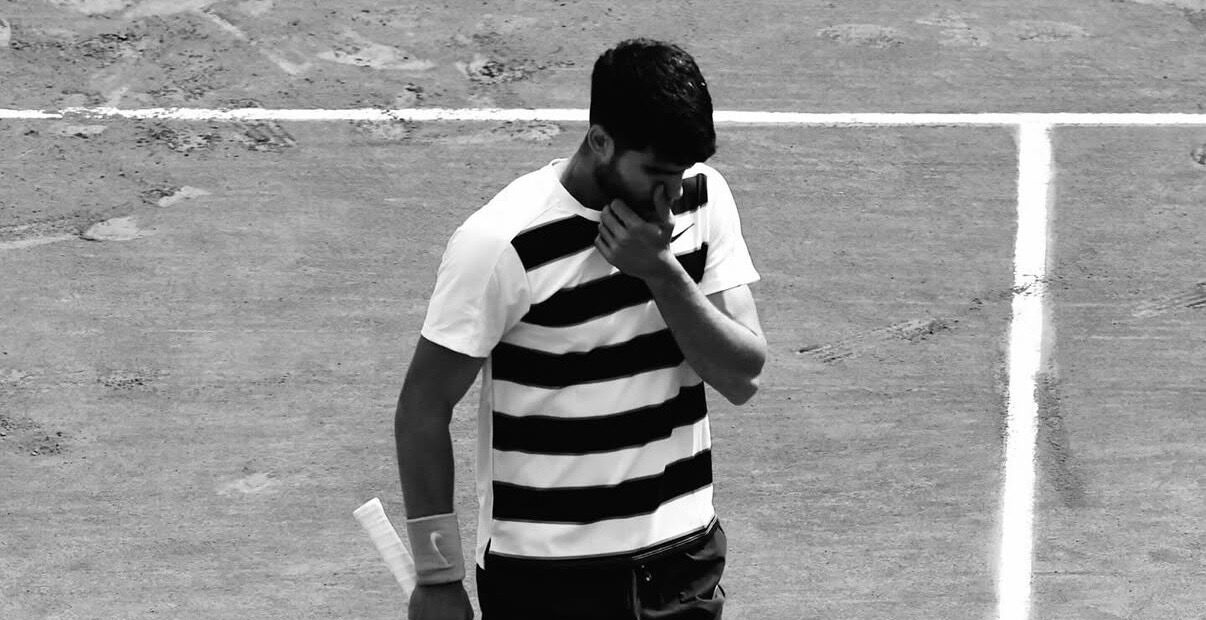
That is why predictions regarding Alcaraz’s return, who withdrew from Madrid, Rome and Roland Garros due to wrist problems, must be grounded in caution.
“Anyone talking at the moment about a return at Queen’s or, at the very latest, at Wimbledon – that is, during the grass-court season – may be a little too optimistic, given the situation and the location of the injury,” Luigi Ansaloni recently wrote in *La Gazzetta dello Sport*.
“At 23, and with a very long career still ahead of him, everyone around Carlos believes there is no reason to rush things. Even if it means being cautious and taking longer than necessary. For this reason, two other scenarios are circulating. The first is a return to the American hard courts, where Alcaraz would defend his titles in Cincinnati and, above all, at the US Open. The second, more extreme: a six-month lay-off, which would mean the end of the season”.
It sounds harsh, it sounds like a long time, but Del Potro’s case was worse, as was that of the Austrian Dominic Thiem, another Grand Slam winner destined for greatness. For them, not being cautious meant the end of their careers.