

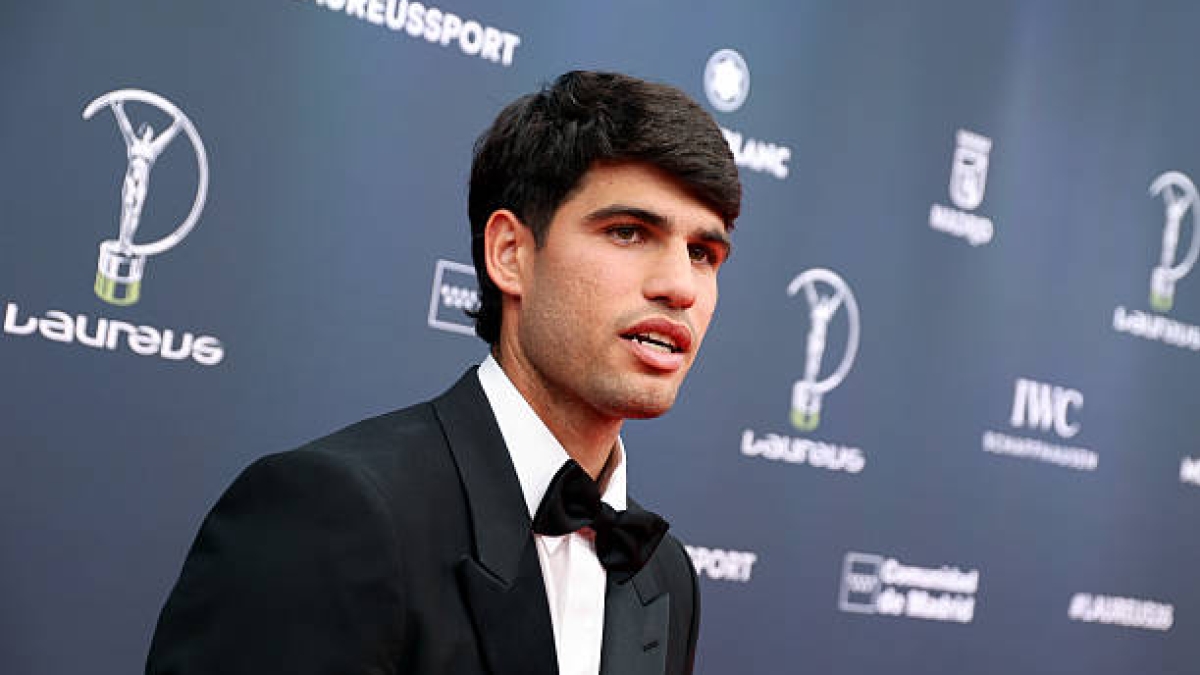

MADRID – The uneasy look on Carlos Alcaraz’s face a few days ago at the Laureus Awards gala in Madrid had a clear reason. Usually smiling and upbeat, the Spaniard appeared troubled and restless amid the uncertainty surrounding his right wrist: something is wrong with that tendon — so wrong that, after withdrawing from Barcelona and Madrid, the world No. 2 confirmed on Friday that he will not compete in Rome or Roland Garros either. A huge blow.
And the worst part for the Spaniard is not the missed opportunity or the 3,000 ranking points he will lose — he won both Rome and Paris in 2025 — but that he does not know when he will return to competition. “After the results of the tests carried out today, we have decided that the most prudent thing is to be cautious and not take part in Rome or Roland Garros, while we assess the recovery to decide when I will return to the court,” Alcaraz explained on his social media. “It’s a difficult moment for me, but I’m sure we’ll come back stronger.”
Después de los resultados de las pruebas realizadas hoy, hemos decidido que lo más prudente es ser cautos y no participar en Roma y Roland Garros, a la espera de valorar la evolución para decidir cuándo volveremos a la pista. Es un momento complicado para mí, pero estoy seguro de… pic.twitter.com/U6PhjtXnBX
— Carlos Alcaraz (@carlosalcaraz) April 24, 2026
With his clay-court season now over, attention turns to Wimbledon (June 29–July 12) and the North American swing that will culminate at the US Open (August 30–September 13). The uncertainty surrounding his return is even greater because Alcaraz has not specified the exact nature of the injury. The issue lies in a tendon in his right wrist, but the type and severity remain unknown. Still, the fact that he has withdrawn from Roland Garros more than a month in advance offers a clear indication of the seriousness of the problem.
Wearing a wrist brace for several days now, Alcaraz has been sending cautious messages. He will not force anything — especially not with a joint like the wrist, which has already derailed the careers of major players such as Dominic Thiem and Juan Martín del Potro. “We have a long career ahead of us, many years. Pushing to play this Roland Garros could hurt me for future tournaments. I’d rather come back a little later and in top shape than rush back too soon and not be ready. You have to take care of yourself — a career can be very long,” he said earlier this week at the Laureus Awards.
That philosophy contrasts with the one embraced by his compatriot Rafael Nadal: extreme sacrifice, playing through pain, giving everything to compete on the biggest stages — above all at Roland Garros. A clear example is the last of his 14 titles in Paris, in 2022: that year he won the tournament with a numbed foot — weeks earlier, the chronic Müller-Weiss condition he has suffered since his youth had flared up again — and left Paris unsure if he would compete again. It is true that Nadal’s career was already nearing its end — he was 36 — and he had fewer chances to fight for another Grand Slam. But his approach to tennis never changed: he built his legacy on pushing his body far beyond its limits. And the high probability of winning in Paris justified any physical cost. There was a mystique of endurance around him.
Alcaraz, by contrast, has set his limit several steps before the edge. The player coached by Samuel López will turn 23 on May 5 and still has a long career ahead if injuries allow. In his case, cool-headed decision-making prevails — especially as he knows his game does not depend on a single surface like Nadal’s once did: Alcaraz has already won the Australian Open, two Roland Garros titles, two Wimbledons and two US Opens. The definition of an all-court player. It makes little sense to put all his eggs in one basket.
Do you love CLAY? Support us on Ko-fi and follow us on Instagram, X (Twitter) and Facebook.