

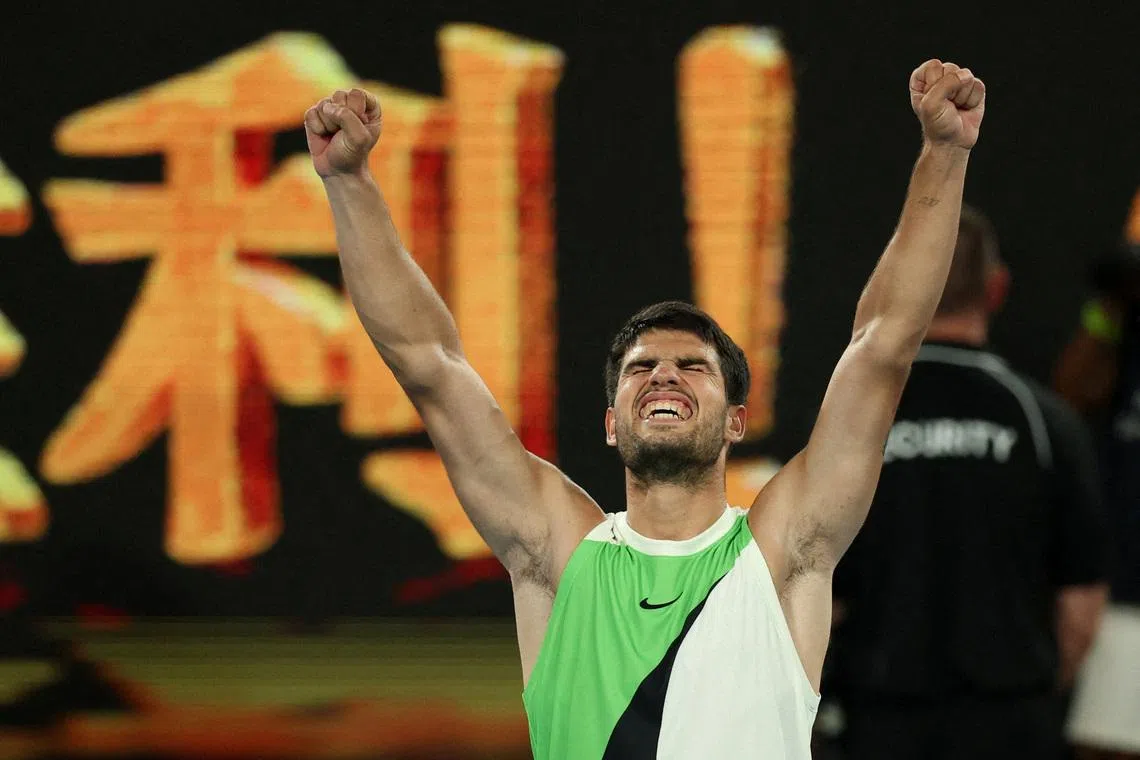

If there’s one word journalism abuses without restraint, it’s “historic.” But this Sunday, 1 February 2026, is one of those rare occasions when even the most hard-line purists will let you not only use it, but overuse it, twist it, and shout it in capital letters. HISTORIC. Or with hyphens. H-I-S-T-O-R-I-C. No one will say you’re exaggerating. No one in their right mind would dare disagree after Carlos Alcaraz’s feat at the Australian Open.
The Rod Laver Arena in Melbourne was the stage for Alcaraz’s latest bite at eternity: with a 2-6, 6-2, 6-3, 7-5 win over Novak Djokovic in a final flatter and duller than the script suggested, the Spaniard captured the only Grand Slam missing from his collection — and reminded the world that all those grand statements and bold declarations he’s made since joining the tour were never just talk. When he said he wanted a seat at the table with the greatest, it wasn’t bravado. When he claimed Björn Borg’s records were fine but that he wanted to break Djokovic’s, he meant every word. In his own way, yes — as the Netflix documentary says — but rewriting history line by line.
Time will tell if he achieves everything he sets out to do. What’s beyond doubt is that he’s on the path toward those seemingly impossible dreams. At just 22, Alcaraz already has seven Grand Slam titles to his name and can boast a career Grand Slam, that is, winning at least once each of the four majors, which is not the same as winning all four in the same season, as Rod Laver did for the last time in men’s tennis in 1969. The boy from Murcia now has two Roland Garros, two Wimbledons, two US Opens and one Australian Open.
Ver esta publicación en Instagram

Consider this: hundreds of millions of people have played tennis. Of those, only a few thousand have done so professionally, and just a few hundred have had the privilege of breaking into the top ten. World No. 1s and Grand Slam champions number only in the dozens. And it takes barely two hands to count the men who’ve won all four majors: Fred Perry, Don Budge, Rod Laver, Roy Emerson, Andre Agassi, Roger Federer, Rafael Nadal, Djokovic — and now Alcaraz. But no one, ever, had completed the career Grand Slam as young as the 22 years and 272 days of the Spaniard from Murcia. It’s a staggering precocity — that’s what’s unprecedented. For context: Nadal did it at 24, Federer at 27, Djokovic at 29. And we’re talking about the Big Three, the three greatest players in history.
Beyond the tangible, beyond the avalanche of stats and milestones, lies the symbolic: to say Alcaraz completed the career Grand Slam in Melbourne would be to undersell it. There are so many layers, so many factors that lift this triumph to an almost mythical dimension. Because it was against Djokovic — unquestionably the greatest player of all time. Because the Serb had won all ten previous finals he’d played on Rod Laver Arena. Because Alcaraz defeated Alexander Zverev in the semifinals despite cramps, vomiting, and a five-and-a-half-hour comeback. Because he carried the weight of a major change on his shoulders, having ended his partnership with Juan Carlos Ferrero during pre-season.
And yet, the final in Melbourne began with a completely unexpected script — with Djokovic utterly unleashed.Approaching his 39th birthday, the Serb, who had taken out Jannik Sinner in the semifinals, came out razor-sharp, playing as if he weren’t 16 years older than his rival, as if he felt no pressure at all. As if this weren’t possibly his last chance to claim the 25th Grand Slam title of his career. He is a colossal player, immense. One day, his ability to still fight for Grand Slam titles at nearly 40, against opponents who could almost be his sons, will be valued as it deserves.
With Rafael Nadal watching from the stands, Djokovic caught Alcaraz off guard early on with the kind of intensity and precision reminiscent of his prime. But, of course, that level is hard to sustain as the years go by. And Alcaraz knew how to wait. He knew how to read the match. He knew that a five-set battle could stretch the Serb to his limits. Bit by bit, he grew into it — clawing back points, chipping away at Djokovic’s confidence. He loosened up, freed his arm: a drop shot here, a lob there, an ace now, a winner next. And his mind held firm — no cramps this time, no fear of the occasion.
He wore Djokovic down, running him ragged from side to side until he delivered the final blow. Seven Grand Slam titles in eight finals now — three of them against Djokovic himself. This time, he didn’t need to summon epic heroics. And yet, he did it against the greatest of all. That’s Alcaraz — a player on his way to becoming infinite.
Follow our coverage of the 2026 Australian Open on our Instagram, X (Twitter) and Facebook accounts.