

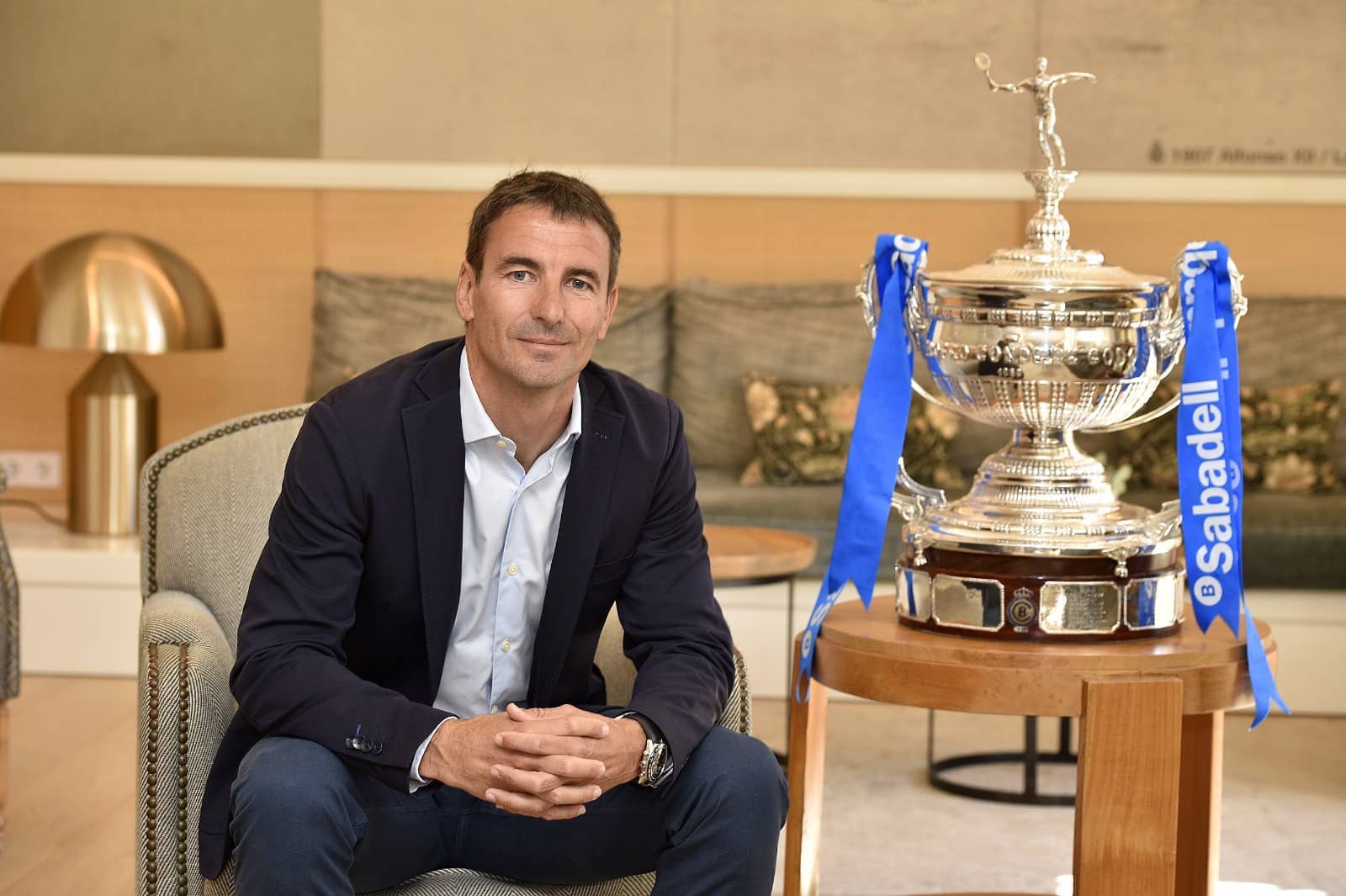

BARCELONA – The Barcelona tennis tournament, known in Spain as “Conde de Godó,” will resist the pressure of the growing Saudi power, believes Tommy Robredo, former world number five and its new director.
Robredo, 43, arrives a few minutes late to the meeting with CLAY by the pool of the Real Club de Tenis de Barcelona. “An urgent matter, sorry,” apologizes the man who was number five in the ATP ranking just a few steps from the pool where on Sunday the champion of the Conde de Godó will bathe. That tradition is not lost and is one of the identity hallmarks of a tournament with a special aroma. While most events are played in facilities as large as they are impersonal, this ATP 500 resists in the same club as always, in a privileged enclave of Barcelona full of soul and history.
“We could organize the event outside, but for the moment we don’t want to because this makes us different, it makes us special. And not just us, but the ATP also values it very much,” said the former Spanish tennis player, champion of 12 ATP titles, in an interview with CLAY. “We are in the pole position of the ATP 500s and we do all the work in case one day we can have some prize of gratitude.”
Interview with Tommy Robredo
– You are debuting this year as director of the Conde de Godó. What have you learned these months?
– I have already been an advisor to the club for 3 years and during those 3 years I have been working at the club and in the tournament. I have been seeing many things. But in the end, what you see is the great work team that exists in the day-to-day, how every aspect of the tournament is worked on so that everything goes as well as possible. This is obviously the function of tournament director, but I more or less already had it clear from having spoken with David (Ferrer) and having seen how they worked.
– Diego Schwartzman said in an interview with CLAY that players are often not aware of the work behind the organization of a tournament. Have you also noticed it seeing now the other side of the coin?
– I was aware because I also have a Foundation and we organized an international wheelchair tennis event. In the end, we wanted to imitate what a professional tournament is so that people could have the best experience possible. So I had to work with sponsors, with media, with marketing, with operations, the venue, the banners, the service to the players… I had a hint of it, and obviously one thing is an ITF tournament for wheelchairs and another very different thing is an ATP 500 like this one is, where everything is multiplied by 20. But more or less I had a hint. And I have always been a person who liked to look at these aspects a lot and I have been grateful when in a tournament they treated me very well.
– There is much talk about the tennis calendar, that it is going toward a circuit with more Masters 1000 and fewer ATP 250. What is going to happen with tournaments like the Godó?
– I have no idea. In the end, there are some licenses already given and the ATP has been with one format for a long time; changing it is not simple. I understand that they want to push to have the best possible and that every time there are better tournaments. That is why we work 100% to give the best service possible and to give more money to the players, more services to the public, to the sponsors… We are in the pole position of the ATP 500s and we do all the work in case one day we can have some prize of gratitude. If that prize arrives, delighted, but if not, we will work to not lose that ‘pole position’.
– The ATP 500s, not being mandatory tournaments for the players, need to pay a ‘fee’ to the big stars. And it usually has a quite high price. For tournaments in the Middle East, money is never a problem. How do you handle this? Is there any possibility of seeing Alcaraz and Sinner together in the same edition of the Godó?
– It can be had, yes, but it is complicated, because the calendar is hard and obviously they come from Indian Wells, Miami, and Monte Carlo. But our goal is to always have the best draw possible, so we will do the maximum to have the best scenario that we can. But well, those things like Sinner and Alcaraz coming are hard to make happen. There are many themes behind it and the economic plane is also very important.
– Now that everything seems to have a price, that there is much talk about the purchase of tournament licenses, what does the Godó have to survive with such good health?
– First of all, it must be emphasized that the license belongs to the club, that is very important. We as a club want to organize the event here. We could organize the event outside, but for the moment we don’t want to because this makes us different, it makes us special. And not just us, but the ATP also values it very much, so we don’t consider other situations. We will see in the future what happens. We have a development plan for the next three or four years, we want to continue growing within the club and make the event even better than it is.
– Does it scare you that tennis ends up being a sport with four Grand Slams and ten mega-tournaments and that the rest is like a second division?
– No, no, I don’t think it will happen. I don’t think it will happen because there are many players to whom you have to give the option to play. I mean, if you look at golf, for example, there they have the European circuit, the Asian one. You look at Formula 1, there is Formula E, Formula 2… Yes, a first division and then the rest… That tennis could end up being something like that… I don’t know. I am speaking without having any idea, but I believe we have a very solid and very well-structured circuit. From there, there could be some small change as there have been in the last 30 years, but a change as radical as you tell me, no…
– In recent times there is also much talk about the demand of the calendar. On one hand, players complain that they don’t stop, but on the other, tournaments need the players to generate income and increase prizes. Is there a solution to this?
– In the end, what all tournaments have to do is have the best draw possible and then they have to have the best sponsors to support them. I always say the same thing, there are three very important legs: on one side, the fan; second, the one who pays for the party—here enter sponsors, institutions, boxes…; and the third leg is the player. If one of the legs limps, well, everything wobbles. Because if there are no fans, there aren’t going to be so many sponsors; and if there are no sponsors, there aren’t going to be so many players. If you make it so the three legs are strong, then obviously everything grows and makes the tournament solid. It is what happens to us. This year, for example, we have set up one more court for the fan, so they have more space, to have drinks, to rest, to watch the match a bit on the screen and I think it is a spot that has turned out super cool.
– The other day Patrick Mouratoglou said that within a few decades, if tennis doesn’t change, it is going to disappear. Do you agree?
– Not at all. The ATP has shown us numbers and they say that the audience has doubled. Sincerely, I don’t know why he says that.
– Do you feel like a tennis purist?
– Yes. I love tennis and I look at everything so that everything keeps improving and is better every time.
– Do you believe any rule should be changed so that tennis is updated, so it is more attractive?
– It’s just that changing something in tennis is very complicated. You have to change the lines, some say. But what are you going to change? The lines of 100 million courts? The simplest thing perhaps is to raise the net a little bit. But I don’t see that it is bad. You can change the balls a little bit, the rackets, but something that is very subtle. Because if not… it all gets messy.
Do you love CLAY? Support us on Ko-fi and follow us on Instagram, X (Twitter) and Facebook.