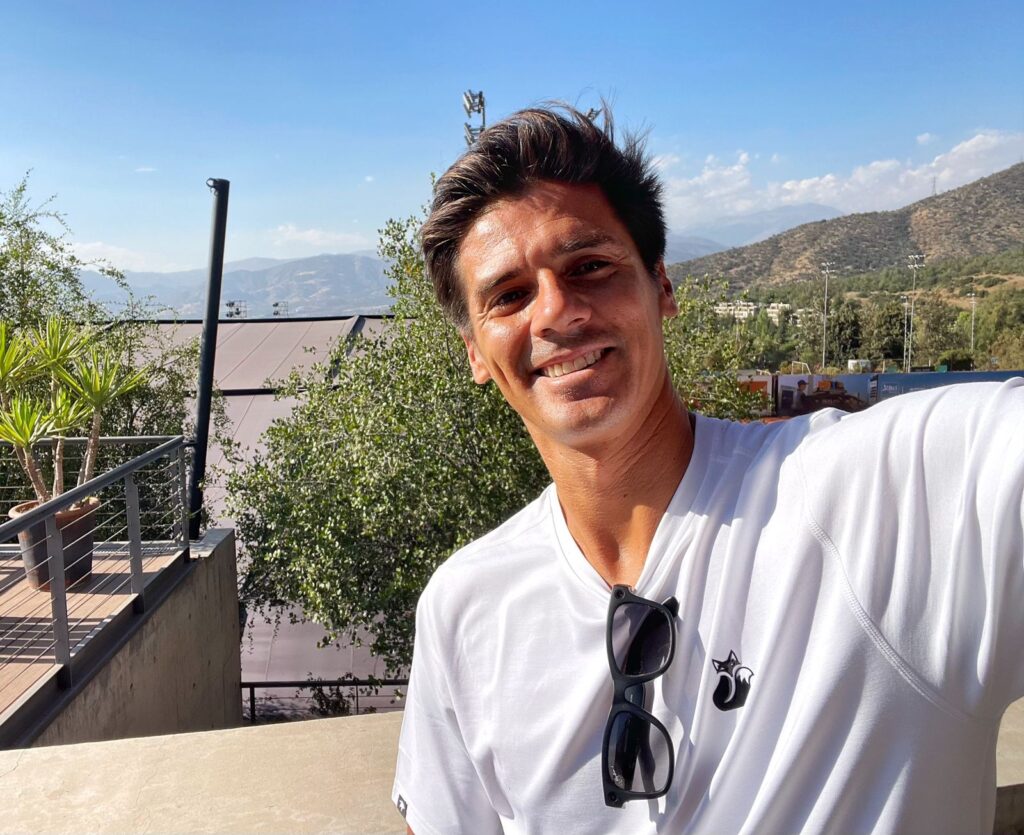


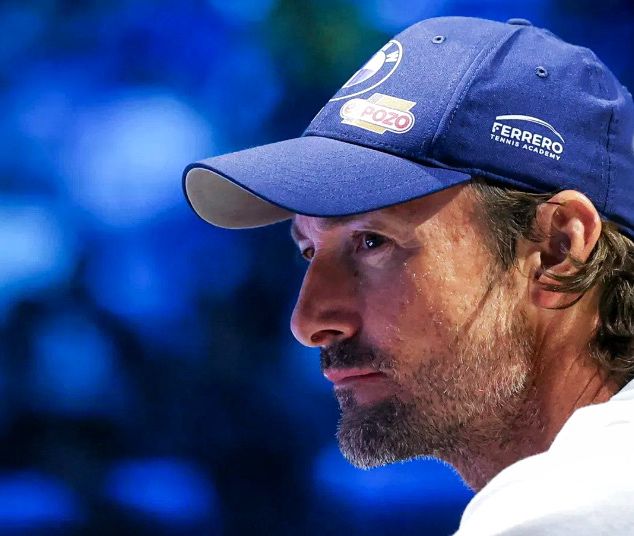

The pain caused by the abrupt end of his partnership with Carlos Alcaraz is beginning to ease, says Juan Carlos Ferrero, who is looking ahead and ruling nothing out: he could one day coach Jannik Sinner. Or he could work again with Alcaraz himself.
“Doors shouldn’t be slammed shut with a blunt no, should they? Just as I could work with Carlos again at some point in the future — who knows — I could also (…) work with Jannik,” Ferrero told CLAY in a phone interview from Bahrain, also published by RG Media.
A former world No. 1 and champion of Roland Garros and the Davis Cup, Ferrero spoke about his new role as coach to a promising young Spanish golfer, Ángel Ayora, clarified still-unsettled aspects of his split with Alcaraz, and referred to the work Samuel López is doing as the new coach of the world No. 1.
What will happen the day he meets Alcaraz face to face again? CLAY asked Ferrero.

“That moment will be difficult, complicated (…). The normal thing would be to have returned to the tour with someone else and then see him, obviously, in a different way. As a rival, right? Of the player I might be coaching.”
Ferrero revealed that he received four offers to coach players “inside the top 20,” three of them men, but turned them down because he does not yet feel ready. And on the horizon remains the idea that there could one day be an “Alcaraz + Ferrero, part two.”
“Yes… yes, of course, of course! In the end, I think shutting doors completely is neither smart, nor good, nor what I feel at this moment.”
Interview with Juan Carlos Ferrero
— You’re in Bahrain right now — had you ever been there during your playing days?
— No, never. I’d been to Dubai, Doha, all those places, but Bahrain was new for me.
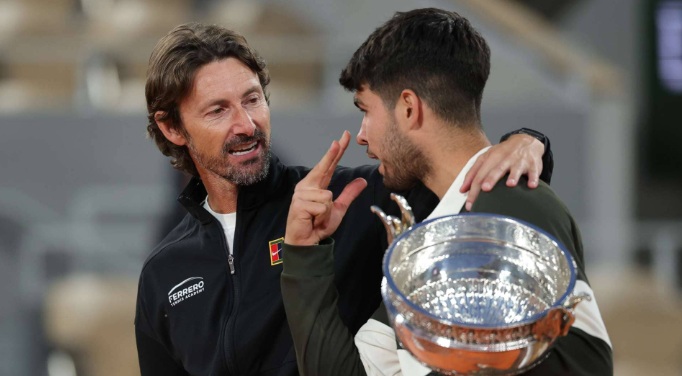
— So golf is opening up new horizons for you…
— It seems so!
— You’ve said golfers train a lot, for long hours. More than tennis players?
— In a way, yes. Since the physical load is different, they can spend more time on the course. A normal training day for Ángel, when he’s not in a tournament, can run from 10 in the morning until six in the evening — hitting balls, playing holes, eating, training again, doing some physical work. Tennis is more specific: two hours, two and a half, maybe three, with a lot of physical training, and that’s it.
— Are you enjoying these first days working in the golf world?
— Very much. I’m getting to know the players, learning how everything works, the rhythm of the tour, trying to understand how to fit in with Ángel’s team so I can help him unlock all the talent he has.
— Your role is more mental than technical, unlike what you did with Alcaraz.
— Exactly. With Carlos, I worked on technical and tactical aspects. Here, I don’t touch that. I focus more on competition: how to deal with difficult moments, manage frustration, courage on the course, body language. Basically, how to compete at 100%.
— Is this a long-term project or something more short-term?
— For now, we’ve talked about a maximum of eight tournaments this year. Golfers play a lot — he’ll probably compete in around 30 events. The idea is to stay in constant contact when I’m not traveling with him, and join him at certain tournaments when we feel it makes sense.
— Is that compatible with coaching in tennis again?
— Yes, it is. But right now, I want to take things calmly. I’ve had some offers, but they didn’t quite fit, mainly because I don’t yet feel ready to jump back into the tennis circuit. I need a bit of a break.
Ver esta publicación en Instagram
— You have three children — how old are they?
— Eleven, eight and five.
— Sounds like a great time to be around them more.
— Absolutely. Two of them are already competing in sports, so they’re also keen to have me there, sharing that experience with them.
— What sports do they play?
— My daughter does artistic gymnastics, my older son plays tennis and football. The youngest, who’s five, does a bit of everything — golf, judo, tennis… he’s still figuring things out.
— You mentioned you received four offers to coach. Men and women?
— Mostly men, but also one woman.
— Top-level players?
— I’d say all of them were inside the top 20.
— Why did you say no?
— After working with Carlos, a player of that level, finding that same excitement again right now is difficult. That’s normal.
— Were you surprised by the huge reaction to your split with Carlos? I can’t recall a coaching breakup ever generating this much attention.
— When you’re outside, you don’t really notice it as much, but in Spain it was definitely a big shock. I was very touched by the affection from people who understand and value the work we did. That part was comforting. And, of course, there was also sadness.
— You spoke with Alcaraz after the split. How was that conversation?
— It was a conversation full of gratitude. He thanked me for everything, and I explained how I had felt through the whole process. We haven’t seen each other since.
— Did you feel he understood your position?
— He makes decisions together with his team. I believe he was aware of everything that was happening.
Ver esta publicación en Instagram
— One detail drew a lot of attention, particularly in today’s social-media-driven world: Alcaraz shared a series of photos about what he described as “the truly important things of 2025”, and you didn’t appear in any of them. Did that surprise you, or did it make sense to you?
— A little, yes — a little. Of course it surprised me, because I was very much part of 2025. But I guess they were already looking toward the future and didn’t want to link me to anything anymore. Once a relationship is broken, it becomes a decision made by the whole team, not just by him. You think about it, you act, you move on — and that’s it. There’s no point dwelling on it if that’s the path they chose. Naturally, I would have liked things to be different, but in the end you have to respect other people’s decisions.
— That post came after you had already spoken?
— Yes.
– You have said that there was a conversation about the contract that destroyed everything, changed everything. You have also said it was not about money, but rather a black-or-white issue. Was it something non-negotiable, or part of a more philosophical decision, of saying: this is as far as I go?
– I am not going to go into much detail. In the end, these are internal matters where we could not agree on certain aspects of a contract that included new conditions. From their side, they saw things one way; from mine, another. And in the end, there was no compromise from either side and no agreement to continue. That is all there is to it. Obviously, we would have liked to finish in a different way. We already had the pre-season planned; this was something that happened suddenly. I did not expect certain changes in certain things, and in the end, they happened. We could not reach an agreement, and that was it. You have to keep moving forward and respect the other parties as well.
– I imagine that since it was an agreement you renewed year by year, there is no severance or compensation for your departure.
– No, that’s right.
– A post of yours on social media also drew attention, in which you used a song with very meaningful lyrics, talking about getting back up, not letting yourself fall. Are we overinterpreting it, or was that song in that specific post a message?
– No, no, honestly it was not. I have already explained in some interviews that there was a period of acceptance, in which everything was very complicated, and at some point you have to get back up and move forward. People speculate a lot and imagine many things, but in reality, some time was needed, and now that a month and a bit has passed, it is time to start rowing forward and looking for new things and new motivations that truly drive you, make you work well, make you happy. And to keep going.
– After a concussion or a very heavy blow, you go through different stages: shock, anger, mourning, acceptance… Which stage do you feel you are in?
– Right now, coming out of the mourning. After a month, it is obviously more than accepted and it is time to think about other things. I am not following the Australian Open very closely. You hear about the results, but I am not watching the matches. In the end, it always hurts a little, doesn’t it? Seeing a whole different team there on the bench, and the nostalgia of having lived so many things. The memories are right there, on the surface, and it always takes a bit of effort.
– I imagine that the day you step back into a tournament, which is your world, and you run into Alcaraz’s team and Alcaraz himself, it will also be emotional.
– Yes, that moment will be difficult, complicated. But it will be a new beginning, to start normalising what the relationship is. Maybe I see him in Madrid because I go to watch the tournament and I am not there (as a coach) with anyone, but normally I would have returned to the tour with someone and would already be seeing him differently, as a rival of the player I might be coaching.
– You have always had a serious image, restrained in terms of emotions, and what these past weeks revealed was a very intimate, very emotional and expressive Ferrero.
– And in the end, I am quite emotional, and even though I am a disciplined person, who believes in a certain type of work, I also have my feelings. When you spend so much time with people, that side of me ends up showing, the part where I am more sensitive.
– Have you exchanged messages with Samuel López?
– For now, I am keeping a bit of distance from everything. I will see Samuel when I return. Obviously, if he wins the tournament I will congratulate him, of course. The same with Carlos. But for now, I am not talking to anyone.
Ver esta publicación en Instagram
– After the split, I imagine you did have a conversation with López, a kind of handover.
– Yes, I did speak with Samuel, yes. I spoke about many things, obviously about the work, about what was going to be done now. From then on, I did not speak further. He is a person with enough experience to know what he had to do.
– Did you hand the player over to him, in a way?
– That is one way of putting it. Decisions were made, he continued and I did not. Everyone follows their own path, we are still partners in our academy and the relationship has to continue. At the beginning it always costs a bit, because you step aside, and with time we hope everything will return to normal.
— Did it seem right to you for López to continue as Alcaraz’s coach?
– Well, I was the one who encouraged him to continue, once he told me that possibility had been put to him by Carlos’s circle. I was the first to tell him yes.
– There was some reaction to your statement that in the future you could coach Sinner, Alcaraz’s biggest rival. What did you mean by that?
– I meant that doors should not be closed with an absolute no, right? Just as I could return alongside Carlos at some point, who knows. Just as I could coach any other player on the tour, one of them could be Jannik (Sinner). I want to clarify that nobody from Jannik’s team has contacted me, although it is true that they sent me a message congratulating me on the work that had been done and saying they were very sorry. But nothing more, in the end nothing more.
– I understand that you feel you could coach Alcaraz again in the future, that you genuinely feel that, that there is a lot of time ahead.
– Yes… yes, of course, of course! In the end, I think closing doors in a blunt way is neither intelligent, nor good, nor is it what I feel at this moment.
– Did you seek psychological help in these weeks, or was it a solitary process?
– My family, my wife. Above all my wife is the one who has fully lived through everything that has happened.
If you enjoyed this interview with Juan Carlos Ferrero, don’t miss many other interviews with the protagonists of the tennis tour. Click here and read much more for free.