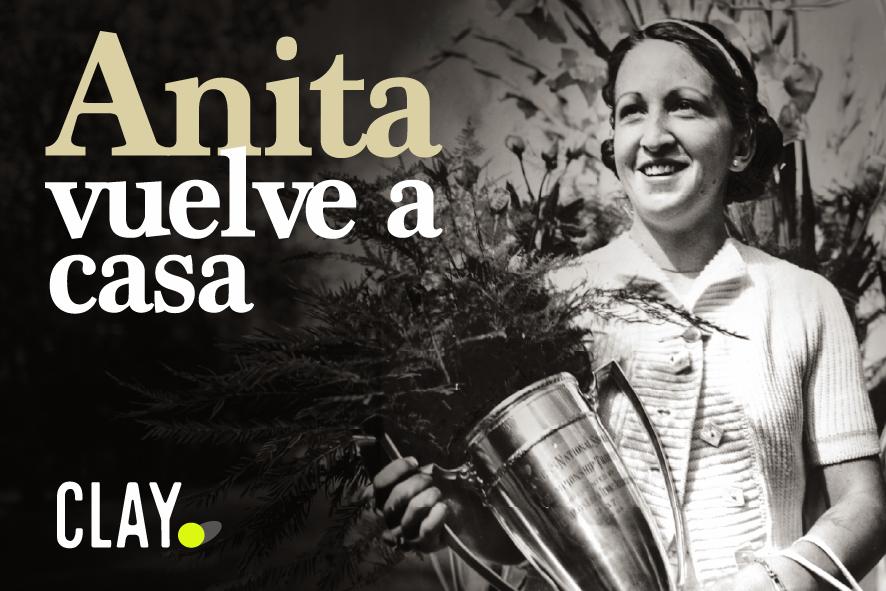

SANTIAGO, Chile — Anita is coming home. Anita Lizana, the great pioneer of Latin American tennis and champion of the 1937 US Open. It took 89 years for Chileans to finally inherit one of the most important trophies in their sporting history.
Her daughters kept the tangible legacy of their mother for more than thirty years in their homes across England, from the time of the player’s death in 1994. But in their houses, only family and friends could admire the cup that turned Lizana into a legend. They realised their mother’s memory would stay more alive with the trophy in Chile. And so they decided to donate it to the country.
“The heart of Chile is what I have in my hands,” says Carol Ellis Lizana, holding the silver cup her mother won. On the clean, well-kept object it reads: “Women’s National Singles Championship Trophy, presented by United States Lawn Tennis Association. 1937 won by Anita Lizana.”
The player’s youngest daughter receives CLAY at her home in Gunnislake, a quiet town in the county of Cornwall, 350 kilometres west of London. She, along with her husband, daughters and granddaughters, is preparing to travel to Chile this month to hand the trophy over to the Chilean people in person: “It is such an important treasure!”
“It completes the circle of my mother’s life that the trophy should reside in Chile, with her legend, with her blood,” Ellis Lizana says.
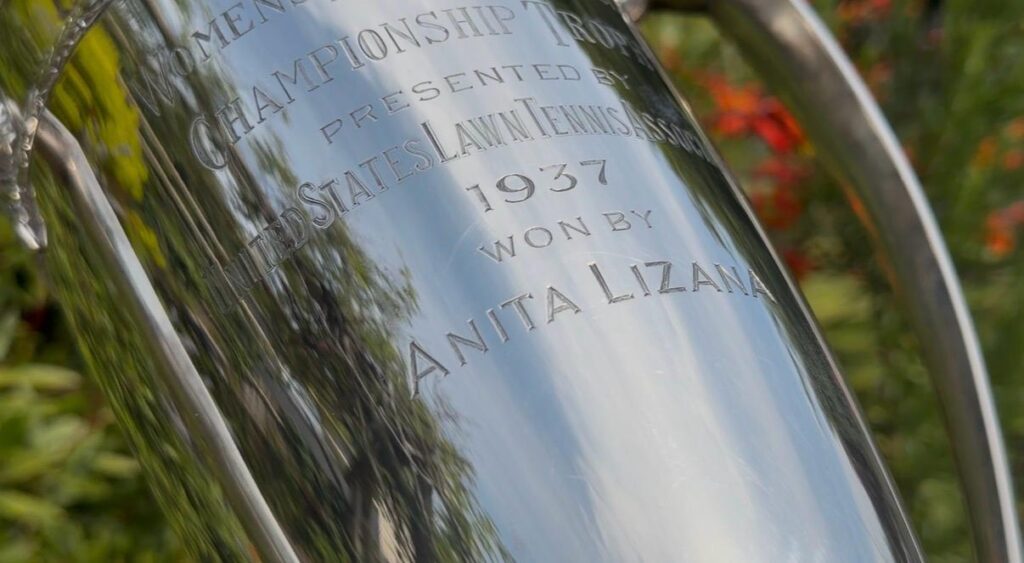
“The trophy is not mine — it is my mother’s. She would have been so happy to pass it on to Chile. We are doing this in her name, for her. It represents her legend and it means something wonderful for people, especially for the young people who are starting to play tennis. For Chilean women,” Carol says.
History in New York
“At Forest Hills, New York, two foreign girls fought at the final of the American Ladies’ single. Señorita Anita Lizana, smiling and playing the game of her life,” a reporter of the time said.
Lizana won on that 11th of September against Polish player Jadwiga Jędrzejowska in the final, completing a brilliant campaign. In the six matches she won, she did not drop a single set. In a sport like tennis, whose historical dominance has been concentrated in Europe, the United States and Australia, Lizana was the first from the “rest of the world” to triumph on the biggest stage.
Ver esta publicación en Instagram
The West Side Tennis Club in Forest Hills, Queens, is a place that keeps memory alive. In what was the home of the Americas’ most important tournament between 1915 and 1977, history is preserved and those who achieved glory there are honoured in detail. In one of the oldest tennis clubs in the world, Lizana’s feat is well remembered.
“The graceful, nimble footed, little champion from South America fairly captivated the gallery with her combination of speed, power, artistry, and rhythmic motion”, Beatrice Hunt reads from the pages of The Fireside Book of Tennis, written by Allison Danzig, who wrote for The New York Times for more than 40 years.
Beatrice, a member and co-chair of the club’s Tennis History and Archives Council, immerses herself in the endless memories held in the club’s library, donated by the widow of Bud Collins, the celebrated tennis journalist who died in 2016. She shows photographs from the collection. The one that catches her eye most is of Lizana having fainted, being carried by a group of men inside the club grounds. After winning, she collapsed from exhaustion and nerves.
“I never thought I would play so well in all my life. My warmest regards to my family and to the Chilean people,” Lizana said minutes after becoming champion in the United States. “I think my burning desire to win was what affected my nerves and caused me the small fatigue,” she told the 17,000 people who witnessed her achievement.
“It was incredible, because it was the first time she came to play here. She did not drop a set. And we never had the pleasure of seeing her play here again,” Hunt tells CLAY.
Lizana married Scottish tennis player Ronald Ellis in London the following year — having first travelled to Chile to get her father’s permission — and the Second World War in 1939 cut short her career and her dream of winning Wimbledon. She spent her whole life in the United Kingdom, and after the War visited her homeland only a couple of times: in 1969 and 1989.
“We are so happy to know that Anita’s trophy will be going to Chile. There is no better place for that trophy to be, because she won it for her country,” Hunt adds.
“Chile was her love. She felt at home in Scotland, but on the occasions she visited Chile, she realised how much she missed it. She was very proud to be Chilean.”, her daughter says.
The celebration of a female icon
“Her triumph means a great deal. Today there is much more equality between women and men. She represents a woman who had it very hard in her time, because it was a man’s world. It was very difficult for women to move beyond the kitchen,” Carol Ellis tells CLAY.
Lizana’s story was also a significant source of inspiration for feminist movements in Chile. In the year she achieved her greatest international milestones — Grand Slam champion and world No. 1 according to unofficial rankings — neither she nor her female compatriots had the right to vote in presidential elections, and married women were legally required to obey their husbands, who also administered their assets.
On October 21, 2026, the Lizana family will be received in Santiago by Chile’s president, José Antonio Kast, and first lady María Pía Adriazola, at the Palacio de La Moneda. It will be the trophy’s first public appearance in the country.
That same afternoon, at the Court Central “Anita Lizana” of the Estadio Nacional, the occasion will be celebrated as a landmark event of great national heritage value, alongside government authorities, prominent athletes and legends of Chilean tennis.
Chile’s only Grand Slam, finally on home soil.