

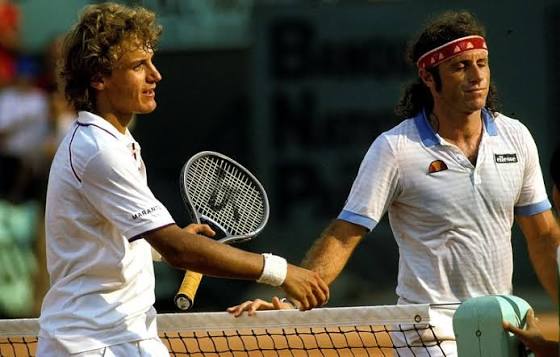

A few weeks ago, former Argentine tennis player José Luis Clerc shed a few tears when talking about Guillermo Vilas in an interview with Infobae. He was moved when recalling the past of the best Latin American tennis player of all time and was also moved by the present, by the neurodegenerative disease that has kept Vilas out of public life for years.
The great Argentine idol’s health is very delicate. And with a disease like Alzheimer’s, the prognosis for the future is not encouraging. That is precisely why Mats Wilander has called on the ATP to consider recognising Vilas as world number one as soon as possible.
“Every day that passes without correcting this is a greater injustice, especially considering his health. Tennis owes a great deal to Vilas,‘ Wilander, who led the rankings for 20 weeks in the late 1980s, told CLAY.
’If there is evidence that Guillermo Vilas was world number one, not recognising it is a historic mistake,” added the former Swedish tennis player during the last Australian Open, a tournament he commented on for Eurosport.

The ‘evidence’ Wilander refers to is well known. So much so that Netflix brought the case to the screen with a documentary entitled ‘You Will Be What You Must Be or You Will Not Be’. The person behind this fight is an Argentine journalist, Eduardo Puppo, who recalculated the rankings of the 1970s—at that time there were several circuits and many more tournament categories than in the current system—to prove that Vilas should have occupied the top spot in the world rankings for five weeks in 1975 and another two in 1976, during Jimmy Connors’ reign.
Puppo spent years researching and even submitted a formal request to the ATP to correct its mistake and retroactively recognise his compatriot as number one. He was not asking for anything unheard of: he was asking for exactly what the WTA did in 2007, when it admitted that Australia’s Evonne Goolagong should have been number one in 1976 ahead of Chris Evert. However, the ATP has always rejected any possibility and has so far denied Vilas, the only four-time Grand Slam champion who has never been ranked number one, that honour.
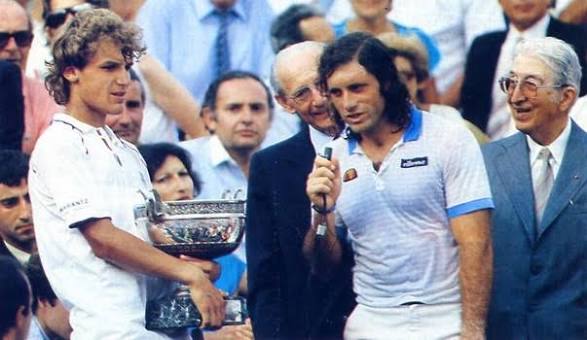
Fonseca, a turning point for Latin American tennis?
Argentine and Latin American tennis see Vilas’ case as a tremendous injustice, a feeling similar to what they have been experiencing for years with the tournament calendar. The birthplace of great tennis players such as Vilas himself, Gabriela Sabatini, Gustavo Kuerten, Juan Martín del Potro, David Nalbandian, Andrés Gómez and Marcelo Ríos, Latin America has been losing a lot of weight in tennis structures. First the rise of Asia and then the push from the Middle Eastern countries have shifted the axis of power. To give an example: only two players from the top 20, one of whom is Argentine, will be at the next ATP 250 in Buenos Aires, a situation similar to that of the ATP 500 in Rio. The big names will be in Rotterdam, Dallas, Doha and Dubai.
When asked about this issue, Wilander puts forward a name that could begin to change this trend, a name that could put Latin America back on track to what it once was. However, the Swede believes that one star is not enough for the continent to regain its position.
‘Latin America didn’t lose talent, it lost structure. Fewer tournaments, less investment, less continuity…,’ the former Swedish tennis player told CLAY. ‘João Fonseca could be a turning point: technically, he has it all. The big question mark is his physical condition. But for the region to truly make a comeback, one star is not enough: systems are needed.’