

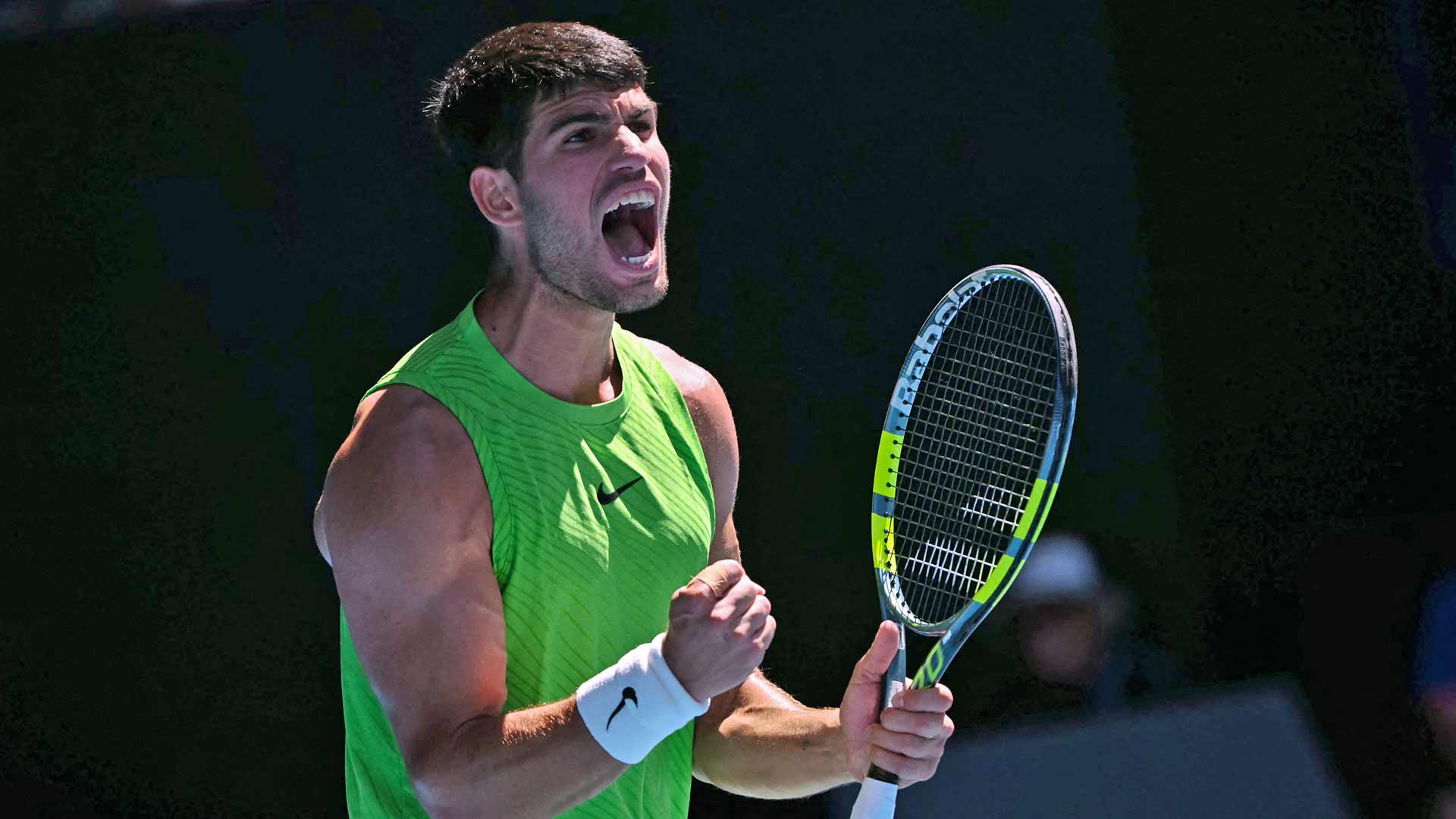

MELBOURNE – Even if he does not win in Melbourne and does not become the youngest player in history to claim all four Grand Slams, the Australian Open will still be etched into the legacy of Carlos Alcaraz. The Spaniard reached the final after winning an epic battle, surviving cramps and physical distress.
The semi-final victory over Alexander Zverev, 6–4, 7–6(7–5), 6–7(3–7), 6–7(4–7) and 7–5 in nearly five and a half hours, was a display of pride, drive and quality.
“I believed the whole time. I always say that you have to believe no matter how much you’re suffering. You have to believe. I suffered in the middle of the third set; physically, it was one of the most demanding matches I’ve played in my career,” he said in his post-match interview.
The first two sets were bliss for the world number one. The third, fourth and the start of the fifth were a nightmare. In the end, when there was almost no margin left, he turned everything into ecstasy.

It was the dream comeback in a fight that pushed him to the limit. Before the problems in his legs, he had already suffered physical discomfort. At 3–3 in the third set, he warned his team: “I’ve thrown up.”
Minutes later, cramps hit both of his legs. Immobilised, he called for medical assistance at 5–4 in that third set. A controversial moment followed.
Zverev exploded at the supervisor: “This is unbelievable! This is bullshit! You can’t treat him for cramps. You protect those two guys all the time.” The reference was clearly to Alcaraz and Sinner.
Tour rules state that players cannot receive medical treatment solely for cramps, as they are considered a loss of physical conditioning, not an acute injury.
The world number one opted to shorten the points. He was stiff. He went ultra-aggressive on the return. It almost paid off when, on Zverev’s serve, he came within two points of closing out the match. The German also helped Alcaraz come so close to the final: he made unforgivable mistakes, served a few double faults, and did not move his opponent around enough.
“Head, heart and balls!” shouted a spectator at the start of the third-set tiebreak, referring to Alcaraz’s trademark phrase. It seemed like his last chance to close out the match. The German won it 7–3.
“I’m starting to feel better,” Alcaraz told his team, led by coach Samuel López, as the fourth set began.
The 22-year-old gradually recovered power and movement, but it was not enough. The match passed the four-hour mark before entering the final set.
Zverev broke early and then had to defend his serve with his teeth in four games, against an Alcaraz lifted by the crowd and, this time, free of cramps.
At 5–4, he broke, and nothing could stop him. A resurrection that will be remembered forever, on the eve of the day that obsesses Alcaraz: on Sunday, he could become the youngest player in history to win all four Grand Slams.