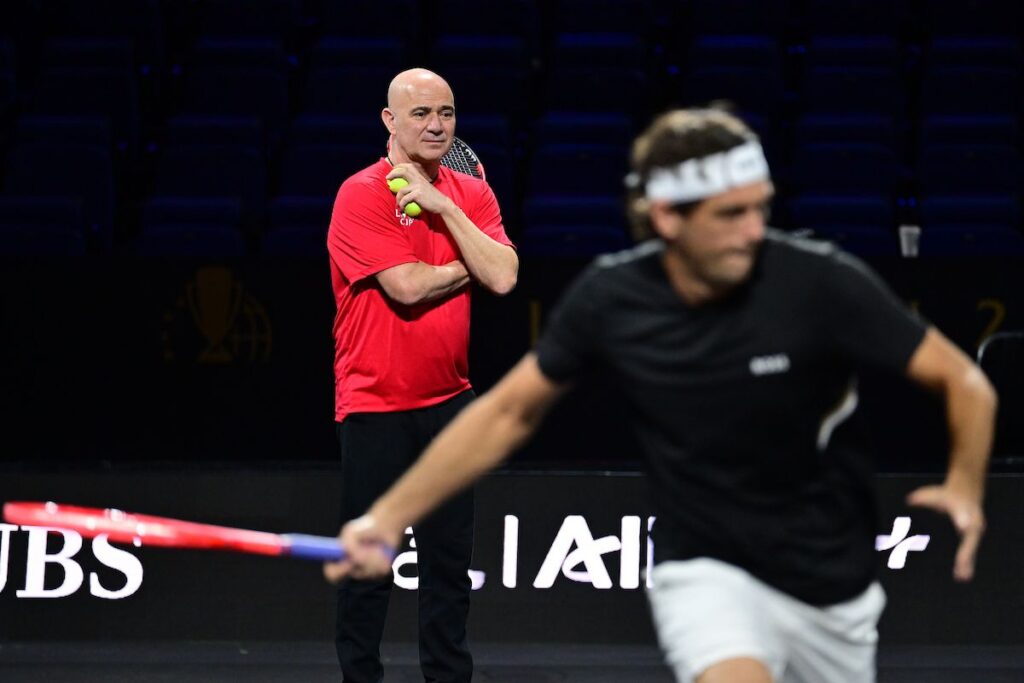


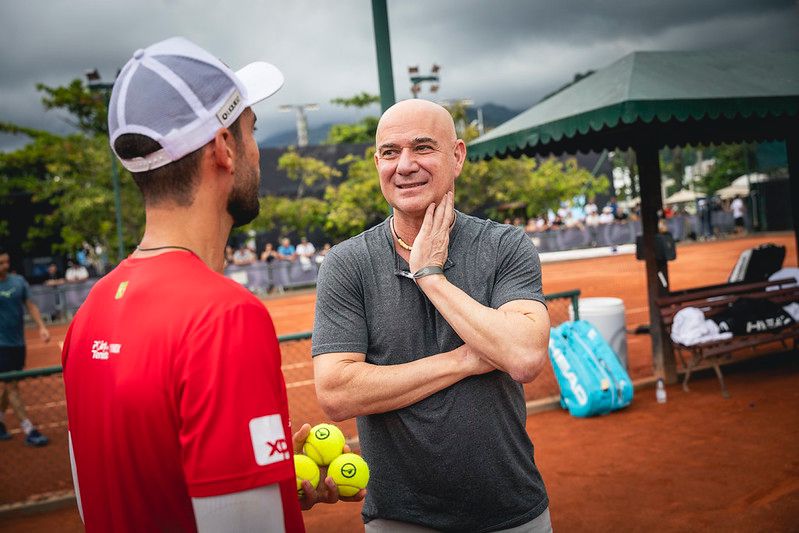

RIO DE JANEIRO – Tennis has become a “big business”, and some players “are now treated almost like corporations”. The words belong to Andre Agassi, one of the most successful players of all time and a close observer of the sport’s evolution.
“If you want to know where something’s headed, follow the money. Tennis has only grown,” the former world No. 1 said in Rio de Janeiro. This Sunday, at the Brazilian ATP 500, the North American will present the trophy to the champion.
The weeks following the Australian Open and leading into the Masters 1000 events in Indian Wells and Miami have highlighted striking contrasts.
The ATP 500 in Doha featured a main draw full of stars, headlined by Carlos Alcaraz and Jannik Sinner. Both reportedly received $1.2 million simply to compete in Qatar — figures far removed from the South American reality.
The US winter tournaments in Dallas and Delray Beach also attracted several top-20 players.
Yet big names do not always translate into packed stands. At several Northern Hemisphere events, the stands have appeared half-empty. The contrast with South America is clear. The Guillermo Vilas Court in Buenos Aires and the Gustavo Kuerten Court in Rio have been full, fuelled by a vibrant atmosphere.
Another detail: none of the eight quarter-finalists in Brazil were ranked inside the top 50; in Doha, the world’s top two were there, along with other high-profile names such as Tsitsipas, Rublev and Mensik. In the South, far more tickets were sold.
Do the tournaments in Buenos Aires, Rio and Santiago need to adapt to the rhythm of the tour to survive? Must the South American swing abandon its clay-court tradition and switch to hard courts? Is that the only way to compete with the Masters 1000 event Saudi Arabia plans to stage from February 2028?
“I don’t know if changing the surface answers every question,” Agassi said in the press room of Rio’s Jockey Club.
“Changing surfaces could influence certain players’ decisions to come down here, because it’s a difficult transition to go from this environment straight to the American hard courts. It takes its toll. We saw it last year with Zverev, who came down here and then needed time to find his footing,” analysed the Atlanta 1996 Olympic champion.
“It’s not easy to go from hard court to the heaviness of this environment. You can feel it in the air — the humidity, the density of the clay, the weight, the slowness — and then go back to hard courts. It’s not easy on the body, not easy on the mind, not easy with the travel. There are so many factors players have to consider.”
Ultimately, Agassi believes tennis becoming big business brings more advantages than drawbacks, whether the focus is on the Middle Eastern desert or on regions where the sport is embraced with greater passion, such as South America.
“I like to see the game grow. I like seeing expansions. I like seeing facilities improve. I like seeing new countries get involved. I like seeing competition and the sport benefit from all of that.”
Join our community on Instagram, X (Twitter) and Facebook.