

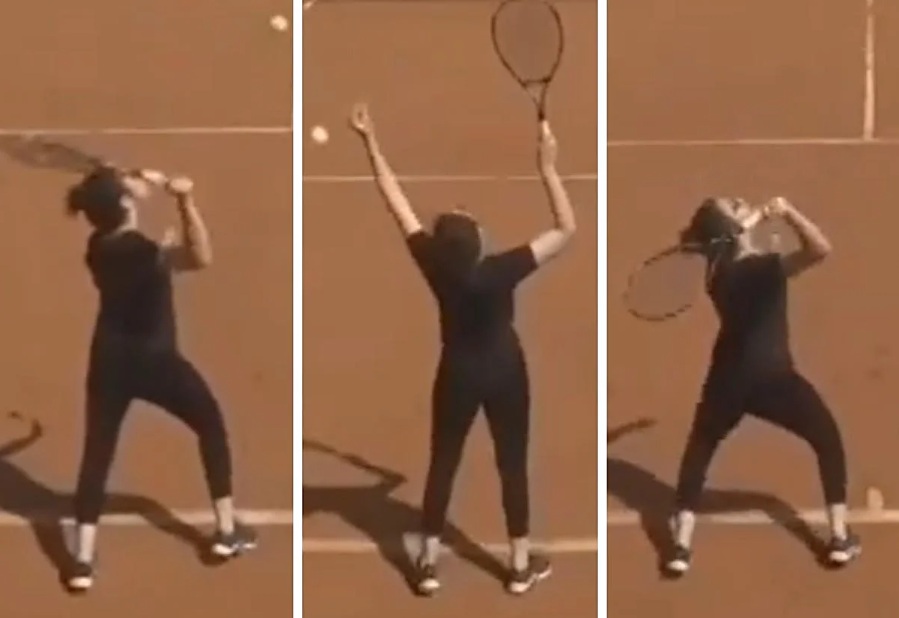

It is most likely that the name Hajar Abdelkader does not ring a bell. But when reading “the tennis player from the viral video who played an official tournament without knowing how to hold a racket and lost 6–0, 6–0”, the image is immediately recognisable.
Beyond the jokes and memes that have flooded social media in recent days, this strange case raises a major question — how is it possible for someone who cannot even hit a forehand to enter the main draw of an international tournament? — and leaves several lessons in the air to ensure that such an embarrassment is not repeated.
The images of Abdelkader not knowing what she was doing on the clay courts of the W35 Nairobi tournament are a serious blow to the sport’s credibility. “It’s a regrettable incident,” a senior tennis insider told CLAY. “It’s very strange to see that level of tennis at a World Tennis Tour event,” the source added.
That source chose the word “strange” rather than “unprecedented” because it is not the first time — and therefore likely not the last. In 2019, at another tournament on the same circuit in Doha, a virtually identical incident occurred with Ukrainian player Artem Bahmet, who lost 6–0, 6–0 without winning a single point.
🔙 En 2019 hubo un caso similar.
El ucraniano Artem Bahmet, de 22 años en aquel entonces, participó en el ITF 15.000 de Doha.
¿Cómo le fue? Perdió 6-0 y 6-0, ganando un total de… 0 puntos.pic.twitter.com/ilLV74WCrC https://t.co/R4hINkLXW5
— Tiempo De Tenis (@Tiempodetenis1) January 7, 2026
But back to Kenya and Abdelkader. Who is the Egyptian ‘non-tennis player’? How did she slip into a tournament that awards world ranking points? Who is responsible for the farce? And what is the organisers’ version of events? We break it down point by point.
The identity of the ‘non-tennis player’, a complete mystery
Who is Hajar Abdelkader?
She is the central figure in the story. What is known is that she is a 21-year-old Egyptian woman — and little else. There are no records of her in any tennis database. The International Tennis Federation (ITF) created a profile under her name for the Nairobi tournament, listing just two additional details: she is right-handed and started playing tennis at the age of 14. In other words, she has supposedly been playing for seven years.
Something does not add up. Based on the footage from Nairobi, either that information is false, or she picked up a racket at 14 and did not touch one again until the age of 21.
Adding to the mystery, the Egyptian Tennis Federation issued a statement saying it had no knowledge of Abdelkader and that she had never been registered as a player in Egypt. “She is not included in any of our official lists,” the federation’s technical director, Dia Nabil Loutfy, told the BBC. “According to the information we have, the player resides in Kenya and took part in the tournament thanks to a wildcard granted by the Kenya Tennis Federation.”

For her participation in the tournament, Abdelkader pocketed $297.
A highly controversial wildcard
Why did the Kenya Tennis Federation grant her a wildcard?
This is the key question. Wildcards are discretionary invitations available at every tournament. Because most tennis events are organised by local federations or entities, these invitations are usually given to young local prospects or veteran players whose rankings have fallen.
At the W35 Nairobi — a tournament on the ITF circuit, the lowest tier of professional tennis — organisers had four wildcards. One went to Kenyan teenager Faith Urasa (19), another to China’s Ada Yan Shihong (17), another to Belgium’s Anouk Vandevelde (18), and the final one to Abdelkader.
According to sources familiar with the case who spoke to CLAY, that fourth wildcard was not originally assigned to Abdelkader, but to another Kenyan player who declined it at the last minute in order to play qualifying instead and try to earn additional ranking points.
Ver esta publicación en Instagram
A structural problem
What went wrong?
Clearly, the tournament’s protocol and the Kenyan federation’s procedures failed. Abdelkader is not to blame for a tournament’s failure to check whether someone listed in the draw is actually a tennis player. Nor can the ITF — which oversees the circuit — control who receives wildcards, as that authority lies solely with the organisers. In other words, this is a structural problem.
Could it happen again?
Absolutely. In 2019, the Bahmet case in Doha already set a precedent. Moreover, the ITF Tour — the circuit that sits between junior tennis and the professional level — spans events across vastly different regions, making oversight difficult.
This week alone, there are women’s ITF tournaments in Thailand, Kenya, Turkey, Tunisia, Egypt, Norway and France, and men’s events in France, the United States, Spain, Egypt, Tunisia and Turkey.
Each of these tournaments is free to distribute wildcards for both the main draw and qualifying at its own discretion.